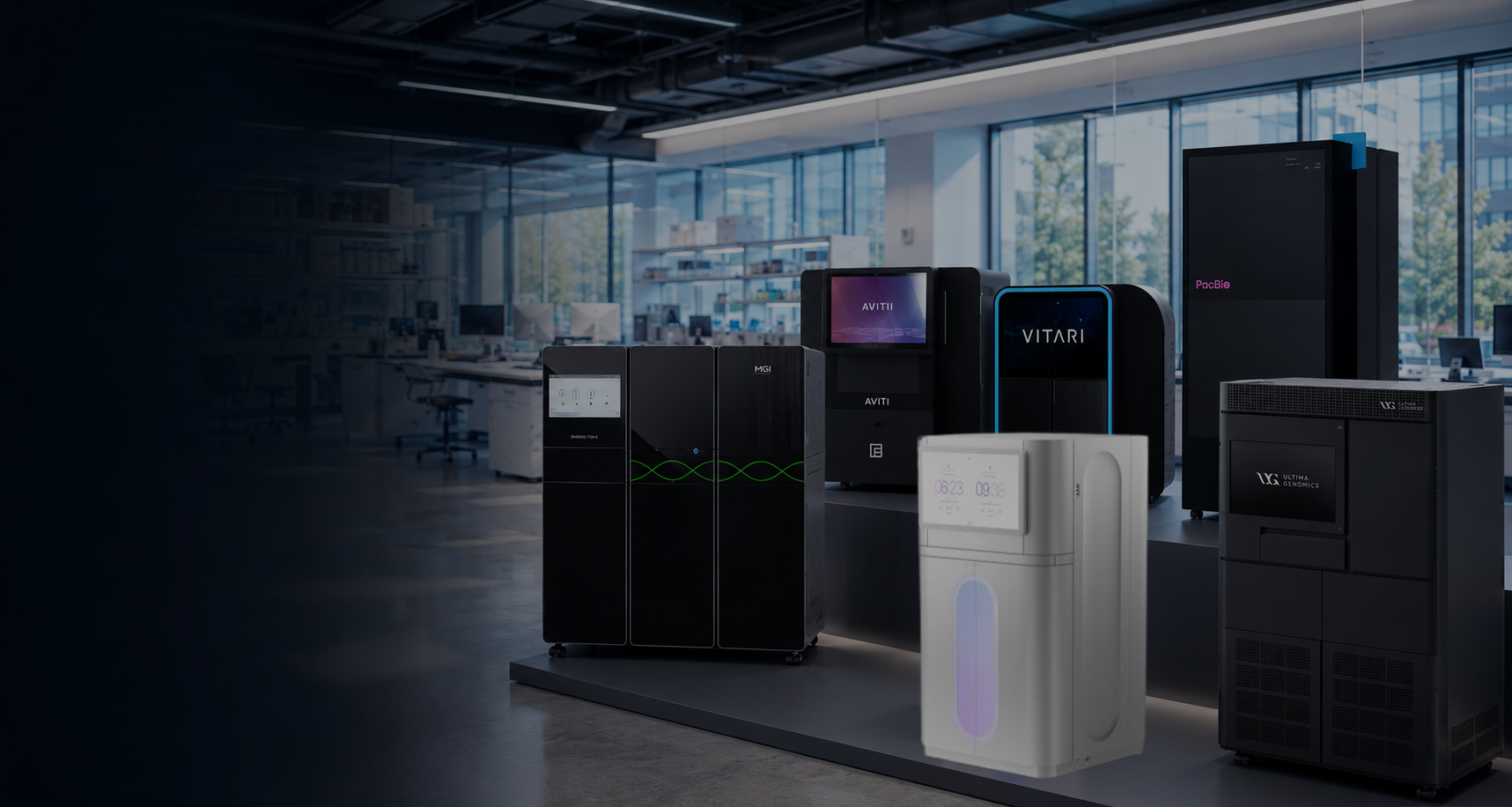
Illumina, MGI, Ultima, Element, Roche and PacBio are pushing sequencing costs lower., but comparing the headline numbers is not as straightforward as it looks.
AT A GLANCE
$0.80/Gb
Ultima public Solaris economics<$100
MGI/Complete Genomics T20×2 genome claim~$150
Reported Roche SBX/Axelios genome economics83%
Estimated NovaSeq X share of Illumina high-throughput Gb in Q2 2026
How much does it cost to sequence a human genome in 2026?
Depending on which announcement you read the answer could be around $80, less than $100, $150 or somewhere below $300. Those numbers can all be legitimate, but they do not necessarily describe the same thing.
Ultima Genomics has published sequencing economics of around $0.80 per gigabase (Gb) for Solaris (and $0.24 per million reads). MGI/Complete Genomics has positioned the DNBSEQ-T20×2 around a sub-$100 genome. Element Biosciences has discussed a $100 genome target for its next higher-throughput platform, while public reporting around Roche's new SBX-based Axelios platform has referenced approximately $150 per genome. PacBio is targeting a sub-$300 HiFi genome (Long reads) at scale with SPRQ-Nx for the Revio platform.
A gigabase, or Gb, is simply one billion bases of DNA sequence. Cost per Gb is useful because it gives us a common unit for comparing how much sequence different platforms can generate for the money.
The problem is that laboratories do not buy gigabases in isolation. They buy instruments, reagents and defined amounts of sequencing capacity. They also have samples to process, deadlines to meet and, importantly, flow cells or sequencing runs to fill.
That is where the headline price starts to become less straightforward.
Want to compare the costs yourself?
We've built an NGS Cost Calculator that lets you compare sequencing platforms using your own sample requirements, utilisation and supplier pricing.
What does a "$100 genome" actually mean?
The $100 genome has been talked about for years as an important milestone for the sequencing industry. Several technologies are now getting close to it or claiming to have passed it.
But a $100 genome usually does not mean that a laboratory can take a blood sample, process it, sequence the genome, analyse the data and deliver a result for $100.
Manufacturers generally calculate these figures using sequencing consumables and the number of genomes that can be produced from a highly utilised run. Sample preparation, labour, data analysis, storage, instrument costs and other parts of the workflow may sit outside that figure.
The amount of sequencing required for a genome also matters.
Complete Genomics' DNBSEQ-T20×2 is a good example. The system was introduced with a sub-$100 genome proposition but it is an enormous production-scale sequencer. Its economics are built around processing very large numbers of samples efficiently. A population genomics programme may be able to use that capacity. A smaller molecular laboratory probably cannot.
Ultima tackles the economics differently. Public figures for its UG100 with Solaris put reagent economics at roughly $0.80 to $1/Gb, depending on configuration. At those prices the sequencing component of a human genome can approach $100 when the system is used efficiently.
Element is worth watching for a different reason. AVITI established the company in the benchtop and mid-throughput market and its next higher-throughput system has been positioned around a $100 genome with approximately 3 Tb of output. If those economics hold under routine use, laboratories may be able to access very low sequencing costs without moving to the scale required by the largest production systems.
Roche also has now added another option. Axelios uses Sequencing by Expansion (SBX), a different method of reading DNA from the sequencing-by-synthesis approaches used by many established short-read platforms. Public reporting has referenced genome economics of around $150, alongside relatively short sequencing run times.
Then there is PacBio. Its target of below $300 per genome with SPRQ-Nx looks more expensive if we compare the number alone, but PacBio produces HiFi long reads. These are long, highly accurate DNA sequences that can provide information that short reads may struggle to resolve, including some structural variants, repeat expansions and phasing.
Putting $100 short-read sequencing and $300 HiFi sequencing next to each other without explaining that difference would therefore be a poor comparison.
What the headline genome prices are telling us
Complete Genomics T20×2: < $100 genome manufacturer claim
Ultima UG100/Solaris: approximately $0.80/Gb public economics
Element: approximately $100 genome target for its higher-throughput platform
Roche Axelios: approximately $150 genome economics reported publicly
PacBio SPRQ-Nx: < $300 HiFi genome target at scaleThese figures use different technologies and assumptions. They are useful indicators of where sequencing economics are heading, rather than equivalent customer prices.
A few years ago, some of these figures would have looked extremely aggressive. Today several sequencing platforms are moving towards them at the same time.
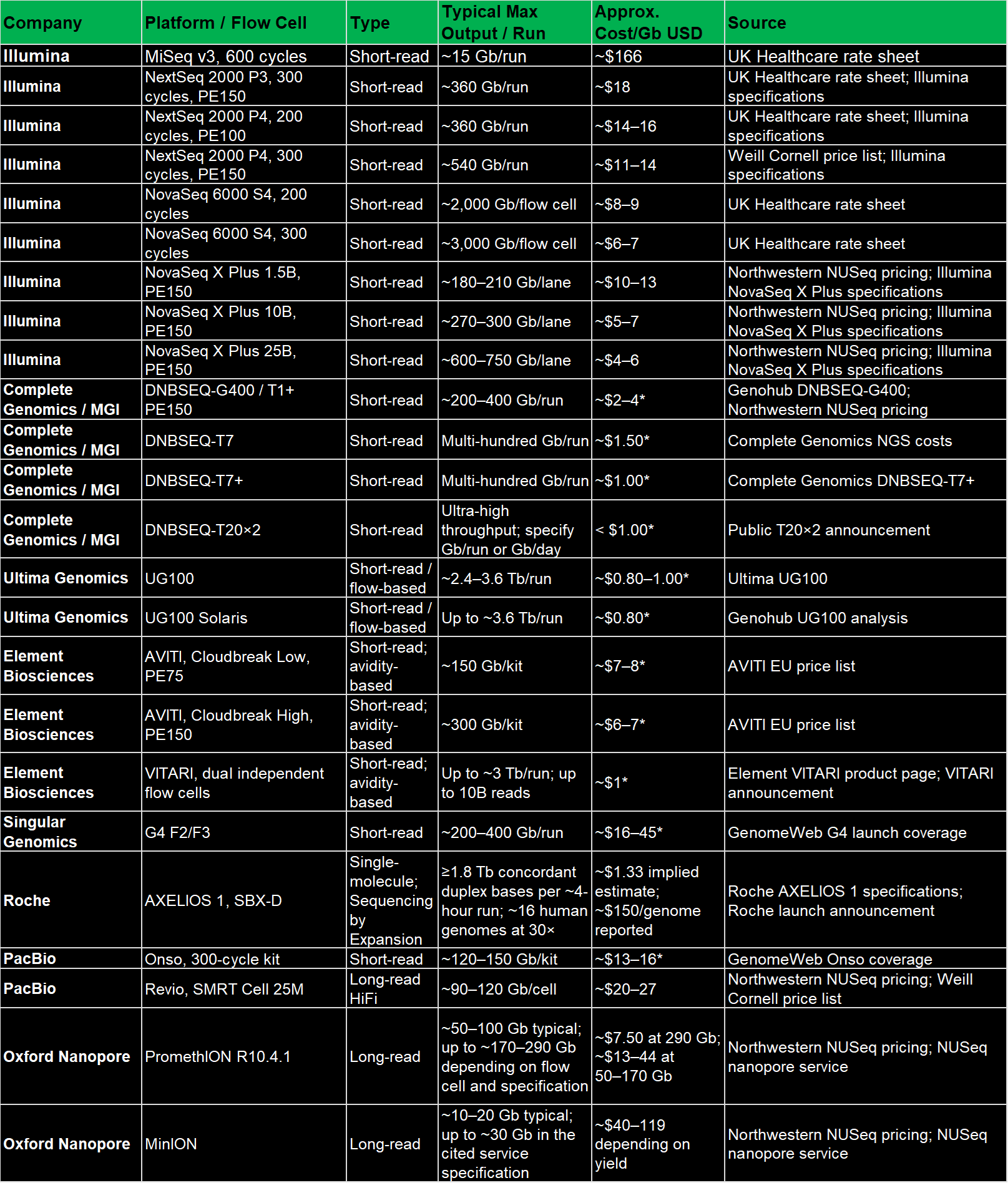
What are the sequencing companies actually offering?
Several sequencing companies are now talking about genome costs at or near the $100 mark. The numbers sound similar but the platforms behind them are quite different.
Complete Genomics: below $100, but at enormous scale
MGI's DNBSEQ-T20×2 sits at the extreme end of the throughput spectrum. The system was launched with a sub-$100 genome proposition and is designed for very large sequencing programmes.
That scale is important. T20×2 is not the sort of instrument a typical molecular laboratory would buy to process a modest number of genomes each week. Its economics depend on having enough samples to make use of an enormous amount of sequencing capacity.
For population genomics programmes, national sequencing initiatives and very large service providers, that can be attractive. For laboratories with lower or less predictable volumes, the cost per genome can be considerably higher if there aren't enough samples to use the available sequencing capacity.
Ultima Genomics: pushing below $1 per Gb
Ultima Genomics' UG100 approaches the cost problem differently. Public figures for the platform with Solaris put sequencing economics at roughly $0.80 to $1 per Gb, depending on the configuration and assumptions used.
At around $0.80/Gb, 100 Gb of sequencing would equate to roughly $80 in sequencing consumables. This is where the idea of an "$80 genome" comes from.
Again that isn't the complete cost of producing an analysed genome. It is the sequencing component under the conditions used to calculate that figure.
The UG100 is also a high-throughput system, so laboratories still need enough work to use the available capacity efficiently.
Element: trying to bring low genome costs to a different scale
Element Biosciences' AVITI established the company in a smaller throughput category than machines such as T20×2 and UG100.
Element's next higher-throughput platform has been positioned around a $100 genome target with approximately 3 Tb of output.
If Element can deliver similar genome economics with considerably less sequencing capacity per run, the number of laboratories capable of making good use of that capacity becomes larger. A $100 genome on a system producing a few terabases per run is a different commercial proposition from a $100 genome that depends on filling an industrial-scale sequencer.
The published target still needs to translate into routine customer economics, but the throughput level is worth paying attention to alongside the headline genome price.
Roche Axelios: cost is only part of the proposition
Roche's Axelios introduces Sequencing by Expansion (SBX). Put simply, SBX converts the DNA sequence into an expanded molecule that is designed to be easier and faster for the instrument to read. This differs from the sequencing-by-synthesis approaches used by many established short-read systems.
Public reporting around Axelios has referenced genome economics of approximately $150, alongside relatively short sequencing run times.
For Roche, $/Gb is therefore only one part of the comparison. Accuracy, turnaround time and how easily the system fits into existing laboratory workflows will also determine whether A. xelios becomes competitive with established sequencing platforms.
There is another reason Roche is interesting. It already has a huge presence in diagnostics. A sequencing instrument does not necessarily have to win purely on the price of the sequence data if Roche can connect it effectively with sample preparation, diagnostics, analysis and clinical workflows...
PacBio: bringing HiFi whole-genome sequencing below $300
PacBio's SPRQ-Nx is probably the clearest example of why we shouldn't rank these platforms purely by genome price. PacBio is targeting a sub-$300 HiFi genome at scale.
On paper, $300 looks expensive next to $100. But a PacBio HiFi genome is based on long-read sequencing, while most of the other examples above are short-read technologies.
Long reads capture much larger stretches of DNA in a single read. This can make them particularly useful for finding structural variants, resolving repetitive regions and determining which genetic variants were inherited together, known as phasing.
Not every sequencing project needs that information. For many routine applications, short reads remain perfectly suitable and considerably cheaper. But where long reads answer a biological question that short reads struggle with, comparing $300 with $100 as though the outputs were interchangeable doesn't make much sense.
So which is actually cheapest?
There isn't enough information in the headline genome price to answer that.
A sub-$100 T20×2 genome comes with enormous sequencing capacity.
An ~$80 Ultima genome reflects very low high-throughput reagent economics.
Element is targeting ~$100 at a different throughput point.
Roche's ~$150 comes with a different sequencing architecture and a strong focus on speed and workflow.
PacBio's sub-$300 target buys long-read information that the short-read platforms aren't designed to provide in the same way.
Why the cheapest cost per Gb may not be the cheapest option
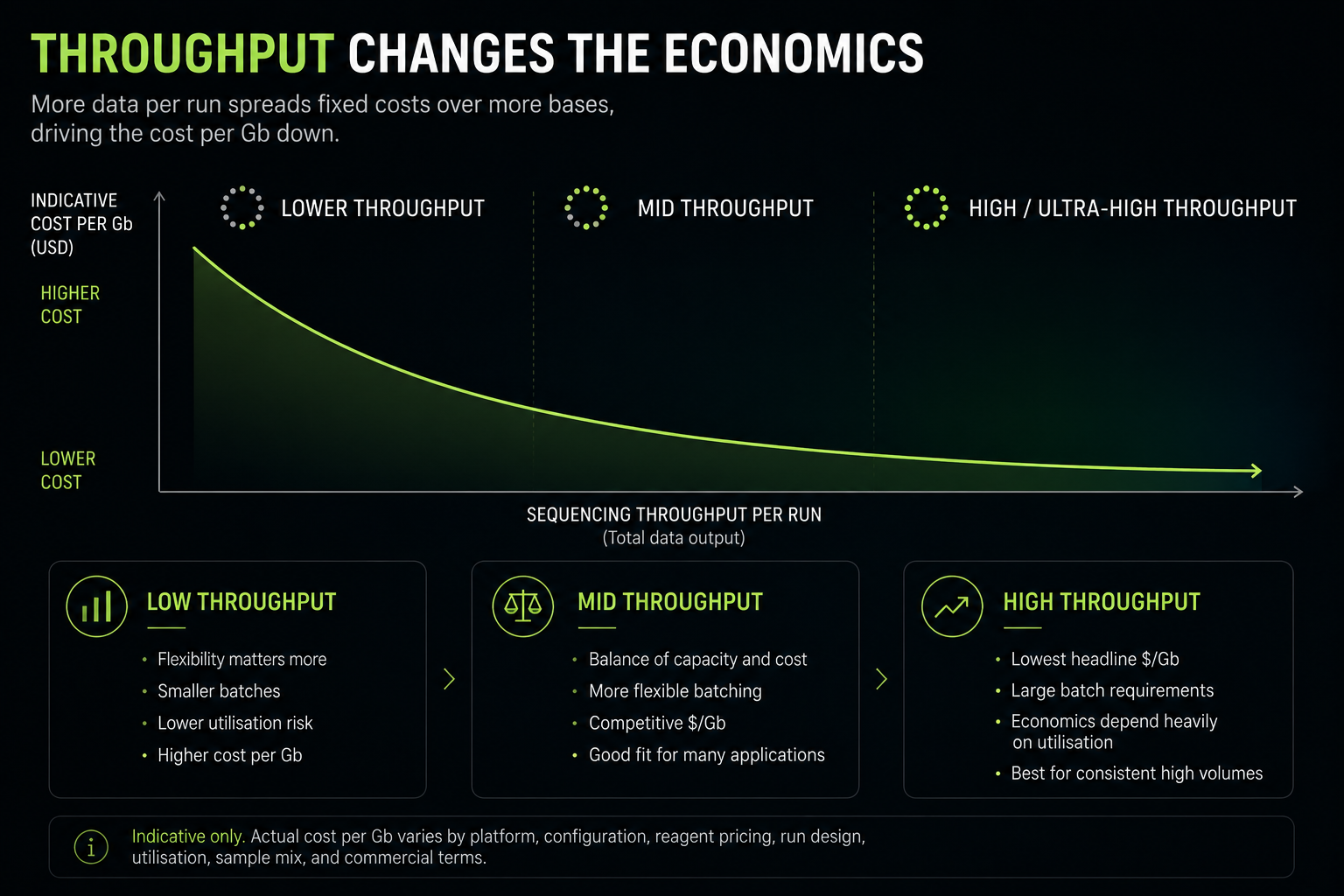
Cost per Gb is still one of the most useful numbers in sequencing, particularly when comparing reagent efficiency. It becomes much less useful if we ignore how much data a laboratory can actually use.
Imagine a laboratory that needs 500 Gb of sequencing each week.
-Platform A produces 500 Gb in a run at $5/Gb. The run costs $2,500 and almost all of the available capacity is used.
-Platform B produces 3,000 Gb at $1/Gb. Its headline sequencing price is five times lower, but the run costs $3,000. If the laboratory only needs 500 Gb, most of that capacity goes unused.
->For this laboratory, the "$1/Gb" platform has not reduced the weekly sequencing bill.
Give the same laboratory enough samples to use all 3 Tb and the calculation changes dramatically.
This is utilisation: the proportion of the available sequencing capacity that a laboratory actually uses. It is one of the most important numbers when comparing platforms, yet it is easily lost when attention is focused on advertised $/Gb.
Batching matters too. A laboratory can wait until it has enough samples to fill a larger run, but that may increase turnaround time. Alternatively, it may accept some unused capacity in exchange for returning results sooner.
That trade-off becomes particularly important in clinical laboratories, where getting a result back quickly can matter more than squeezing every possible gigabase out of a flow cell.
Why mid-throughput sequencing remains competitive
The lowest $/Gb numbers tend to come from very high-throughput systems. That does not mean every laboratory should be moving towards the largest sequencer it can afford.
Many laboratories sit somewhere in the middle. They need considerably more capacity than a small benchtop system provides, but they do not generate enough samples to keep an ultra-high-throughput instrument busy.
Illumina's NextSeq family has served this part of the market for years. Element's AVITI has added another option, while MGI offers DNBSEQ platforms across several throughput levels.
For these laboratories, usable capacity can matter more than maximum capacity.
For example a cancer laboratory running time-sensitive targeted panels may prefer smaller and more frequent runs. A population genomics centre processing thousands of whole genomes has a completely different requirement.
This is one of the reasons a higher cost per Gb can still produce a sensible overall business case. Paying more for the data you actually need can be cheaper than buying inexpensive data that regularly goes unused.
A better question than "Which platform has the lowest $/Gb?"
Ask: How much of the sequencing capacity are we realistically going to use?
Compare the answer at different sample volumes. A platform that looks attractive at 90% utilisation may look very different at 50%.
Instrument price can change the answer again
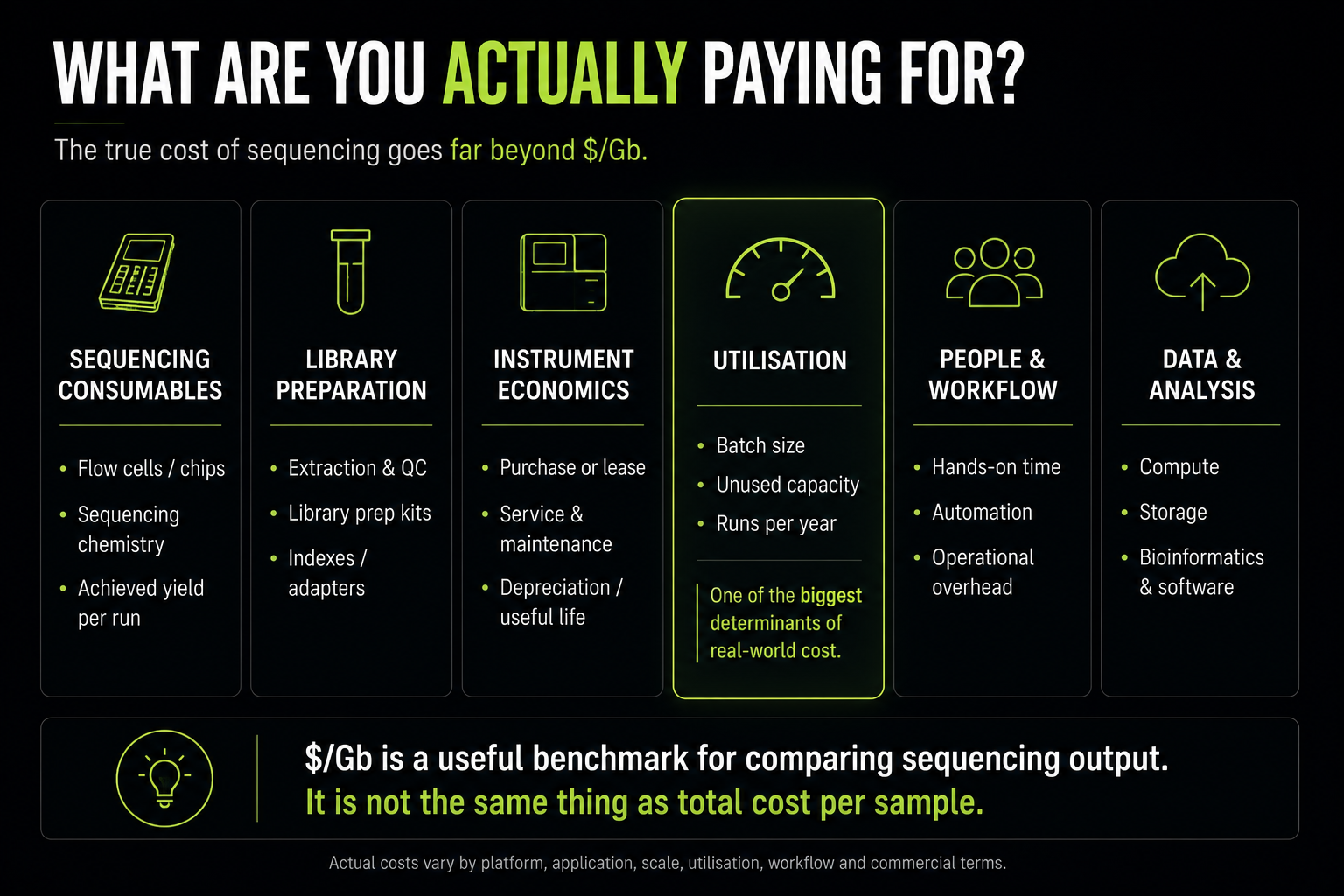
Reagent pricing is only one part of the calculation. Laboratories also need to recover the cost of buying and maintaining the instrument.
Suppose Platform A costs $300,000 more than Platform B but saves $20 in sequencing consumables for every sample processed.
The laboratory would need to process roughly 15,000 samples before those reagent savings recover the additional $300,000 purchase price. That calculation is before service contracts, financing and other operating expenses are included.
If the saving increases to $50 per sample, the break-even point falls to approximately 6,000 samples.
That is why instrument price should be considered alongside expected sample volume and reagent savings over several years.
A useful comparison should include the purchase price, expected number of runs each year, reagent cost per run, realistic usable output and service costs. Laboratories wanting a more detailed picture can then add library preparation, labour, computing and data storage.
This produces something much more useful than a single $/Gb figure: an estimate of when one platform actually becomes cheaper than another for your workload.
Cheaper sequencing creates a challenge for the sequencing companies too
Sequencing manufacturers have historically generated substantial recurring revenue from consumables. Every time a customer runs an instrument, they need another flow cell, reagent kit or equivalent consumable.
Newer instruments can produce much more sequence data while reducing the amount customers pay for each gigabase. That is excellent for expanding sequencing applications, but it changes the economics for the manufacturer.
Illumina's transition to NovaSeq X gives us a useful example. Analysis of its Q2 2026 results estimated that NovaSeq X generated approximately 83% of Illumina's high-throughput gigabase output but 59% of the associated dollars.
In simple terms, customers were generating a very large share of their high-throughput sequence data on NovaSeq X, but the revenue generated per unit of that data was lower.
That does not necessarily mean revenue falls. Lower prices can encourage customers to sequence more samples, run deeper experiments or use sequencing for applications that were previously too expensive. The commercial question is whether that additional demand grows quickly enough to compensate for lower revenue per Gb.
It also makes the rest of the workflow more valuable. Illumina has expanded into informatics, multiomics and application-specific workflows. Element is building beyond sequencing into multiomics. MGI has expanded its portfolio beyond conventional sequencing through technologies such as CycloneSEQ for long-read sequencing and STOmics' Stereo-seq for spatial transcriptomics. PacBio is pushing HiFi further into clinical genomics, while Roche enters sequencing with an established diagnostics and pharmaceutical business around it.
The sequencer may remain at the centre, but there is money to be made before and after DNA actually passes through the instrument.
So what should a laboratory compare?
Start with the work the laboratory actually expects to do.
How many samples will arrive each month? What applications will be run? How much sequencing does each sample require? How quickly are results needed? Can samples wait to be batched? And is volume likely to be very different three years from now?
Once those questions have answers, the platform comparison becomes much more meaningful.
At minimum, we would look at:
Cost per run: what you actually spend each time the instrument is run.
Usable output: how much of the advertised sequencing capacity you realistically expect to obtain and use.
Cost per sample: often more meaningful operationally than cost per Gb.
Utilisation: how full the available sequencing capacity is likely to be.
Annual reagent spend: based on realistic run frequency rather than maximum theoretical utilisation.
Capital and service costs: the cost of owning and maintaining the instrument.
Total cost of ownership: the broader cost over the expected period of use.
Run the calculation at more than one sample volume as well. If demand turns out to be 30% lower than forecast, the best platform on paper may no longer be the best platform in practice. Run our calculator
Where sequencing pricing is heading
MGI and Ultima are pushing very low costs at high throughput. Element is pursuing lower sequencing economics in a different instrument footprint. Roche has entered with a new sequencing architecture. PacBio continues to bring down the premium for accurate long-read sequencing. Illumina still has the scale and installed base of the market leader, while NovaSeq X gives its customers considerably more sequencing capacity at lower cost per Gb.
For laboratories, this is good news. There are more credible choices and the cost of generating sequence data continues to fall.
It also makes purchasing decisions harder.
A platform offering $1/Gb can be more expensive for a particular laboratory than one offering $5/Gb. A more expensive instrument can save money over five years. A platform with lower throughput can be the better operational fit. Long-read sequencing can justify a higher cost when the additional information matters to the application.
The headline price is useful. The workload tells you whether you can actually achieve it.
About this analysis
This analysis uses publicly available manufacturer disclosures, investor presentations, product announcements, published pricing information and public sequencing-facility rates. Manufacturer cost claims are treated as manufacturer claims rather than customer quotations.
Commercial sequencing prices vary by geography, configuration, purchasing volume and contractual terms. Sequencing-facility rates can also include labour and overhead, so they should not be treated as equivalent to manufacturer reagent prices.
Organisations considering a platform should obtain current commercial quotations from the relevant manufacturer or authorised supplier.
We have also developed our own NGS Cost Calculator that lets you compare sequencing platforms using your own sample requirements, utilisation and supplier pricing.
[Compare NGS platform costs →]
Sources
UK HealthCare - NGS Research Services Pricing, June 2025–June 2026. MiSeq, NextSeq 2000 and NovaSeq 6000 pricing and output. View source
Illumina - NextSeq 1000 and NextSeq 2000 Specifications. P3 and P4 flow-cell output and read configurations. View source
Weill Cornell Medicine - Genomics Resources Core Facility FY2027 Price List. NextSeq 2000, PacBio Revio and other sequencing service pricing. View source
Cornell Institute of Biotechnology - Illumina Sequencing Rates. Illumina sequencing service pricing and output assumptions. View source
Northwestern University NUSeq Core Facility - Pricing. NovaSeq X Plus, PacBio Revio and Oxford Nanopore sequencing service pricing. View source
Northwestern University NUSeq Core Facility - FY26 Approved Rates. Detailed sequencing and flow-cell service rates. View source
Northwestern University NUSeq Core Facility - Next-Generation Sequencing Services. NovaSeq X Plus and other platform specifications. View source
Salk Institute - Next Generation Sequencing Scheduling and Rates. NovaSeq 6000 and NovaSeq X Plus service pricing. View source
Genohub - Illumina NovaSeq X Plus. Platform specifications and indicative reagent economics. View source
Genohub - Complete Genomics DNBSEQ-G400. Platform specifications and indicative sequencing economics. View source
Complete Genomics - Next-Generation Sequencing Costs. Manufacturer-reported DNBSEQ-T7 sequencing costs. View source
Complete Genomics - DNBSEQ-T7+. Platform information and manufacturer-reported sequencing cost claims. View source
Complete Genomics - DNBSEQ-T20×2 Sub-$100 Genome Announcement. Publicly reported throughput and sub-$100 genome claim. View source
Ultima Genomics - UG100 Sequencing Platform. UG100 specifications and manufacturer-reported sequencing economics. View source
Genohub - The Ultima Genomics UG100. Analysis of UG100 throughput and sequencing economics. View source
Element Biosciences - AVITI European Price List. Cloudbreak sequencing kit pricing and output. View source
Element Biosciences - $200 Genome Program. Manufacturer-published programme pricing for whole-genome sequencing. View source
Element Biosciences - VITARI. Platform specifications, including sequencing throughput and read capacity. View source
Element Biosciences - VITARI Launch Announcement. Manufacturer-published platform performance and sequencing economics. View source
GenomeWeb - Singular Genomics G4 Launch Coverage. G4 F2/F3 output and reported pricing information. View source
GenomeWeb - PacBio Onso Pricing and Performance. Onso sequencing output and reported pricing information. View source
Roche - AXELIOS 1 Sequencing System. Official SBX technology, throughput and run-time specifications. View source
Roche - AXELIOS 1 Launch Announcement, June 2026. Official launch information and performance claims. View source
Reuters - Roche Launches AXELIOS 1, June 2026. Independent reporting on the platform launch and reported sequencing economics. View source
Northwestern University NUSeq Core Facility - Nanopore Sequencing. PromethION and MinION sequencing yield information. View source
Northwestern University NUSeq Core Facility - Long-Read Sequencing Services. PacBio and Oxford Nanopore service information. View source
Manufacturer-reported costs and sequencing-core service rates are not directly equivalent. Manufacturer figures may assume maximum yield, high utilisation or specific configurations, while core-facility rates can include operational and service costs. Actual commercial pricing also varies by geography, purchasing volume, configuration and negotiated agreements.