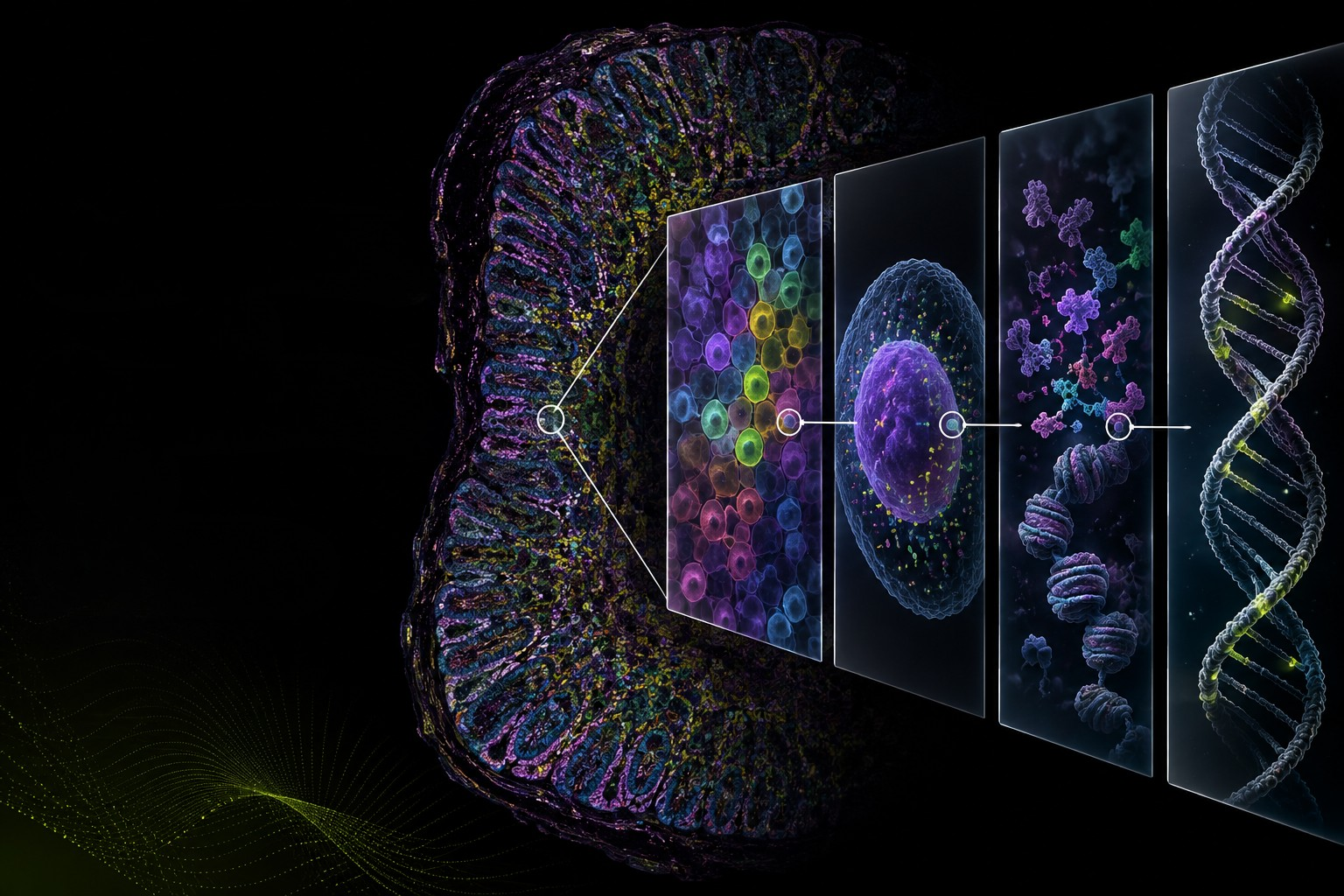
For much of the last decade, progress in omics has been driven by our ability to measure more. More genes, more cells, more proteins and more data. Single-cell sequencing was a major part of that shift because it allowed researchers to move beyond average signals across large populations and see what was happening inside individual cells.
But single-cell sequencing also exposed a limitation. To analyse individual cells, tissue generally needs to be dissociated, and once that happens much of the original tissue architecture disappears. We may know which cells were present and what they were expressing, but not necessarily where those cells were sitting, which populations surrounded them or what was happening in their immediate environment.
Spatial biology is helping put that context back. At the same time, advances in epigenomics are giving researchers another piece of the picture: information about the regulatory state influencing how cells behave in the first place.
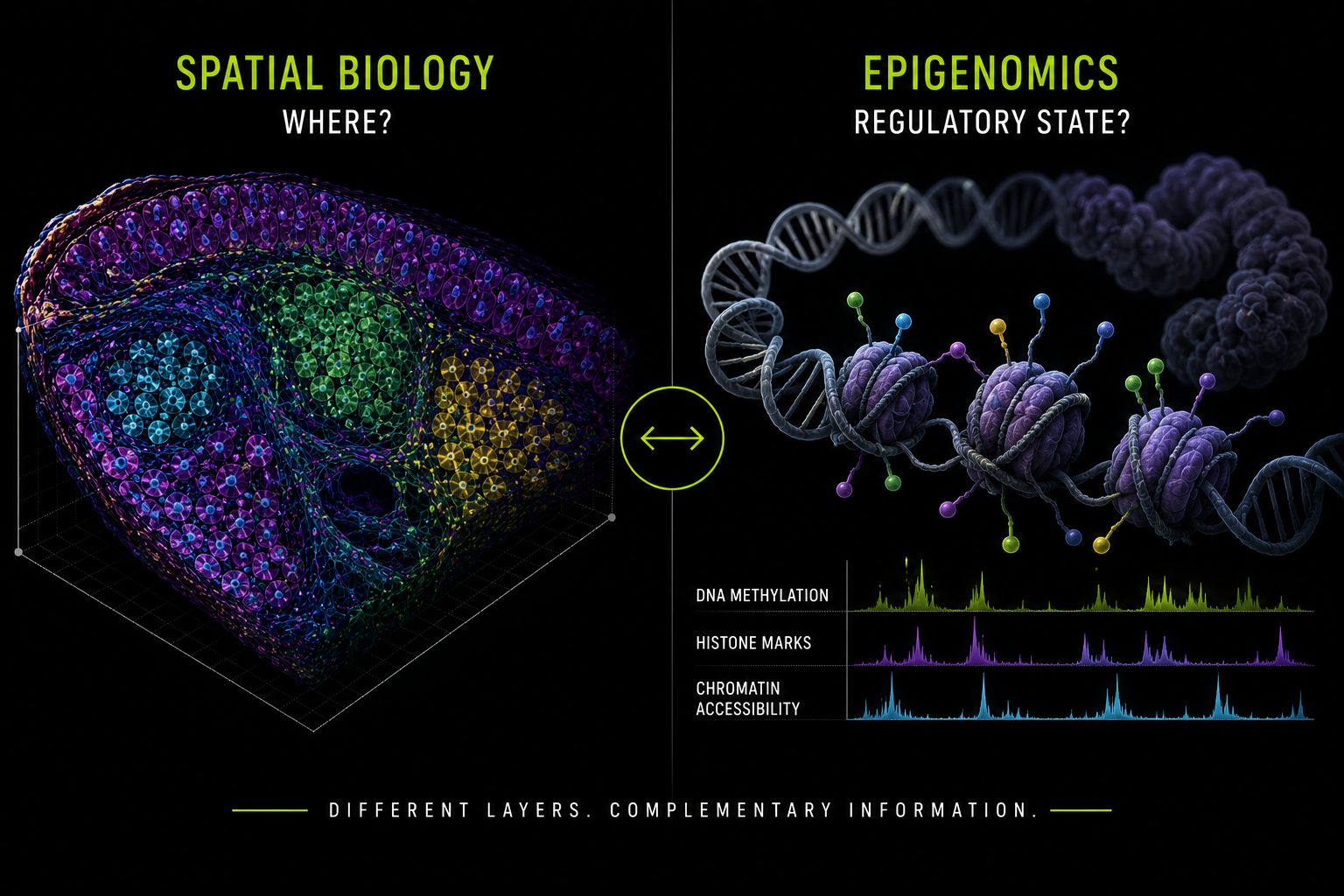
These are different fields, and they shouldn't be treated as though they are interchangeable. Spatial biology is concerned with where molecular activity occurs, while epigenomics helps us understand how the genome is being regulated. What makes them interesting together is what is happening around them. Sequencing companies are moving into spatial, spatial platforms are adding more molecular measurements, long-read sequencing can detect sequence and DNA modifications together, and newer technologies are beginning to connect information that previously required separate experiments.
The result is a much bigger change than simply having another omics technology to choose from.
Spatial biology puts cells back into context
Take a tumour sample. Single-cell RNA sequencing can reveal tumour cells, T cells, macrophages, fibroblasts and other populations, along with the genes those cells are expressing. What it may not preserve is how those populations were physically arranged in the original tissue.
That arrangement can contain important biology. An immune cell infiltrating the tumour may tell us something quite different from the same cell type sitting around its periphery. Tumour boundaries, immune niches, blood vessels and interactions between neighbouring cell populations can all become difficult to reconstruct once the tissue has been dissociated.
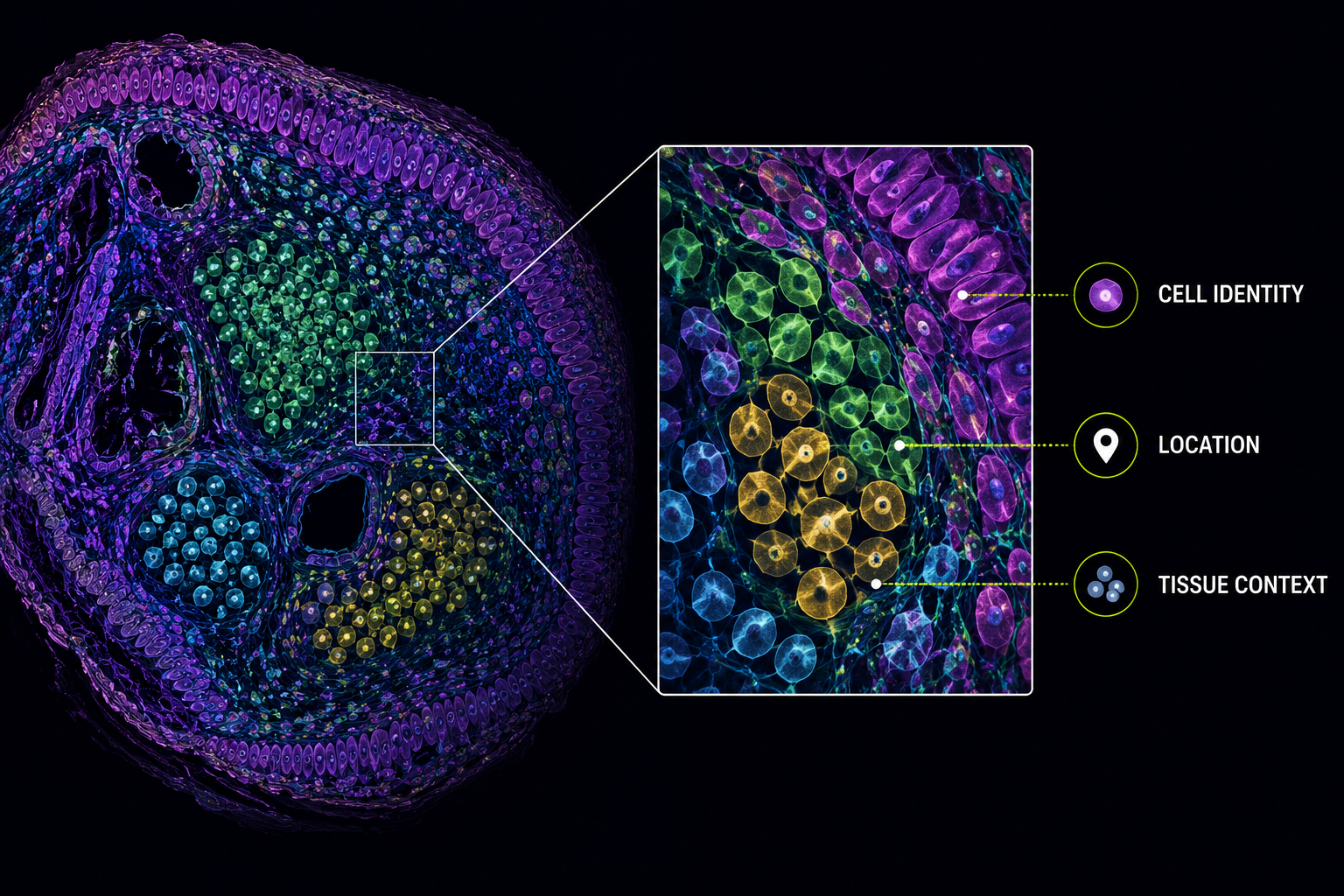
Spatial biology allows molecular measurements to be linked back to their position within the tissue, and the technologies available to do that have expanded quickly.
10x Genomics now has a broad spatial portfolio around Visium and Xenium. STOmics' Stereo-seq (distributed by MGI) has pushed sequencing-based spatial transcriptomics towards large tissue areas, high resolution and whole-transcriptome analysis. The technologies originally developed by NanoString, including GeoMx and CosMx, now sit within Bruker's Spatial Biology portfolio, while Vizgen, Resolve Biosciences, Stellaromics and Singular Genomics are approaching spatial measurement in different ways.
What makes the market particularly interesting now is that spatial is no longer developing neatly alongside sequencing. Established NGS companies are moving into it too. Illumina's StrataMap Spatial brings spatial transcriptomics into the Illumina ecosystem, while Element Biosciences has taken AVITI24 beyond conventional sequencing towards in-sample measurements combining molecular information with imaging and morphology.
So the technology decision is becoming more complicated than choosing the platform with the highest plex or smallest pixel. Researchers may need to weigh whole-transcriptome against targeted approaches, sequencing against imaging, tissue area against resolution, sample compatibility and whether RNA, protein or other measurements need to be captured together.
Spatial biology adds something conventional sequencing often loses: information about where molecular activity is happening within the tissue.
And that leads naturally to another question. Knowing where a cell is and what it is expressing still doesn't fully explain why two cells containing essentially the same DNA can behave completely differently.
That is where epigenomics becomes important.
Epigenomics adds another piece of the picture
Knowing where a cell is and what it is expressing still doesn't fully explain why two cells containing essentially the same DNA can behave so differently. Part of that answer lies in how the genome is being regulated.
Epigenomics looks at features such as DNA methylation, chromatin accessibility and histone modifications. These don't change the underlying DNA sequence, but they are associated with how different parts of the genome are used. If transcriptomics gives us a view of which genes are being expressed, epigenomics can provide information about the regulatory state associated with that expression.
This has applications across cancer, development, ageing, neurological disease and biomarker discovery, but the technologies used to study it vary considerably. Illumina supports established workflows including methylation arrays, ATAC-seq and ChIP-seq, while companies such as Active Motif, Zymo Research and EpiCypher have developed tools around chromatin and methylation profiling.
Long-read sequencing has added another option. Oxford Nanopore Technologies can detect certain DNA modifications directly from native DNA alongside the sequence itself, while PacBio supports methylation detection alongside HiFi sequencing. This is useful because genetic sequence and aspects of its modification state no longer always need to come from completely separate experiments.
Other companies are trying to combine even more information within the same workflow. Biomodal, formerly Cambridge Epigenetix, is developing approaches that generate genetic and epigenetic information from the same DNA molecules.
Epigenica's EpiFinder takes a different approach. Its GenomePro workflow is designed to profile multiple epigenetic targets across multiple samples in parallel. According to Epigenica, a single experiment can analyse 24 samples against eight epigenetic targets, producing up to 192 quantitative ChIP-seq tracks.
24 samples × 8 epigenetic targets = up to 192 quantitative ChIP-seq tracks in one GenomePro experiment.
Epigenica-reported platform specification.
There is an important caveat around that example. EpiFinder is relatively new and much of the performance information currently available comes from Epigenica itself. Independent validation will give a clearer picture of how the workflow performs across different laboratories and applications. What makes it worth watching is the attempt to make epigenomic profiling more multiplexed and scalable, particularly for studies where several regulatory marks need to be examined across larger numbers of samples.
The epigenome is also becoming relevant beyond measurement. Chroma Medicine, Tune Therapeutics and Epic Bio are developing epigenetic editing technologies intended to alter gene activity without necessarily changing the underlying DNA sequence. These aren't competitors to research platforms such as EpiFinder. They are therapeutic companies, but their emergence shows how the regulatory layer of the genome is becoming something researchers are looking not only to measure, but potentially to manipulate.
The more interesting question is what happens when these layers connect
Spatial biology and epigenomics are still different fields, but looking at them together reveals something broader happening across omics.
Genomics provides the underlying sequence. Transcriptomics tells us which genes are being expressed. Proteomics brings us closer to cellular function. Epigenomics adds information about regulatory state, while spatial technologies preserve information about where those molecular events are taking place.
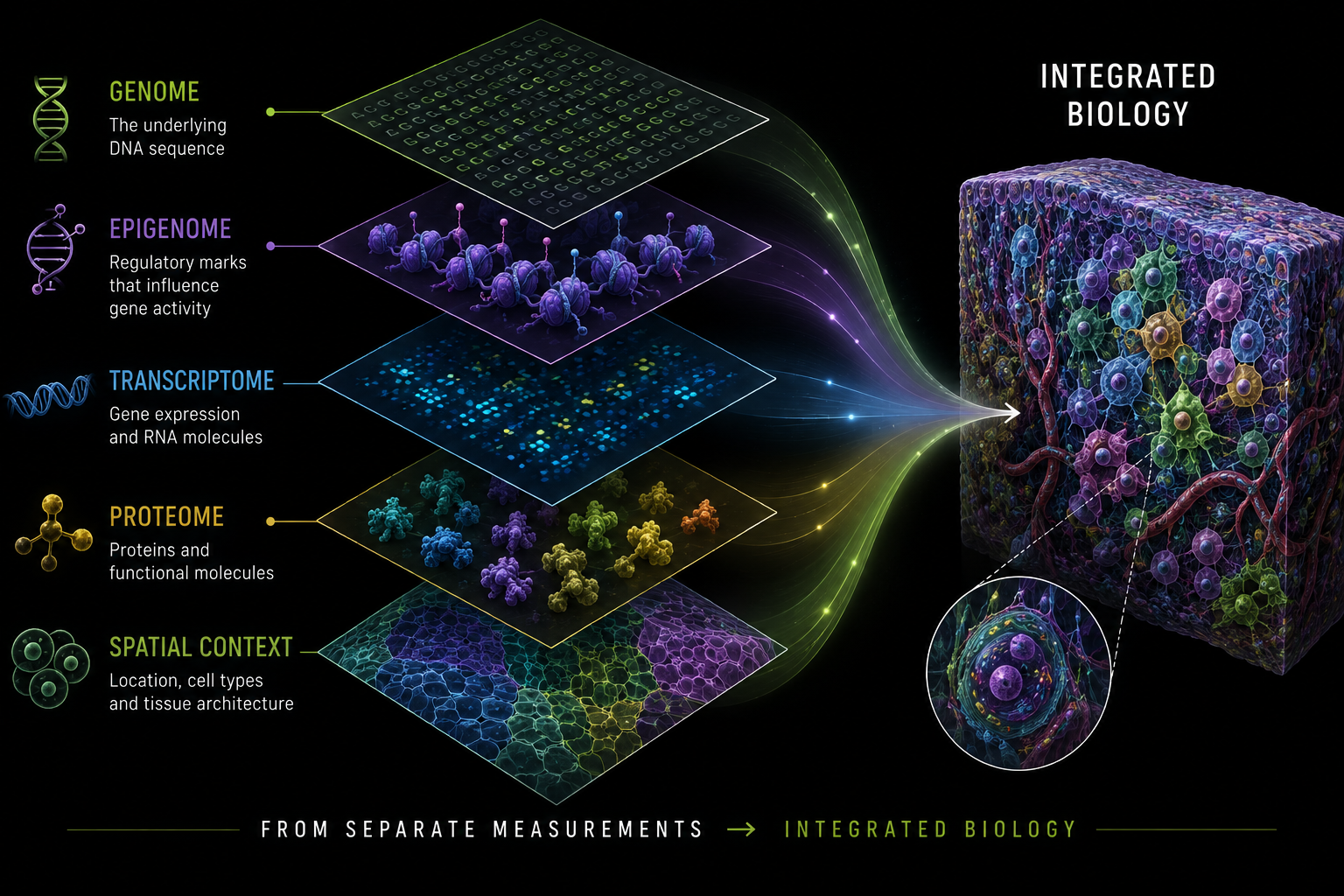
Historically, we have often generated and analysed these datasets separately. Biology doesn't operate in those neat categories. Chromatin state can influence gene expression, which affects protein production and cellular behaviour. Those cells are also interacting with neighbouring cells, signalling molecules and physical structures within tissue.
This is why the push towards multiomics is more interesting than simply adding another measurement to an experiment. The value comes from being able to connect information that would otherwise be analysed independently.
We're already seeing this in the platforms being developed. 10x and Bruker have expanded spatial technologies beyond RNA alone. STOmics is developing Stereo-seq within a broader spatial multiomics ecosystem. Element is bringing sequencing, RNA, protein measurements, imaging and morphology closer together. Biomodal is connecting genetic and epigenetic information from the same DNA molecules, while Oxford Nanopore and PacBio can generate sequence and modification information from native DNA.
Emerging spatial epigenomic methods take this another step further by trying to preserve physical tissue location while measuring regulatory features such as chromatin accessibility or DNA methylation.
Think about what that could mean in a tumour. It is useful to know that a particular regulatory state exists somewhere within the sample. It becomes more informative if we can determine which cells have it, where those cells are located, which genes they are expressing and what is happening in the surrounding tissue.
Instead of running separate experiments to ask what cell is this?, where is it? and what might be regulating it?, the longer-term goal is to connect those questions within the same biological context.
The next step in omics may be less about finding another layer to measure and more about connecting the layers we already have.
More measurements don't automatically mean more insight
This creates a different problem for laboratories deciding which technologies to adopt. Specification sheets make it easy to compare gene counts, plex, resolution, tissue area, throughput and cost per sample, but the platform with the biggest numbers isn't necessarily the one that will produce the most useful experiment.
The starting point still has to be the biological question.
If you're working with archived FFPE tissue, sample compatibility immediately matters. If the question depends on interactions between neighbouring cells, preserving spatial information may be essential. If you're looking for previously unknown biology, a whole-transcriptome approach may make more sense than a targeted panel. If regulatory state is important, RNA expression alone may not provide enough information.
Resolution needs the same scrutiny. Being able to measure at increasingly fine spatial scales sounds attractive, but there is little value in paying for additional resolution if it doesn't change the biological interpretation. The same applies to adding protein, morphology or epigenetic measurements simply because the platform makes them available.
There is also a computational cost to all of this. A spatial transcriptomic dataset is already substantial. Combining spatial coordinates with RNA expression, protein measurements, morphology and epigenetic information creates a much more complicated integration problem. Laboratories need the computational infrastructure and expertise to turn those measurements into something biologically interpretable.
That is why I don't think the next phase of omics will be won simply by whoever produces the most data.
We have already become remarkably good at generating molecular information. The harder problem is deciding which information actually needs to be measured together, and whether connecting those measurements gives us an answer we couldn't get from any one of them alone.
For spatial biology and epigenomics, that is what makes the next few years particularly interesting. Both fields are still developing quickly on their own, but some of the most useful advances may come from the points where they begin to overlap.