Some enormous biotech financings have been announced in 2026. We looked at where the biggest private rounds are going and what investors appear willing to back.
A $2.1 billion Series B is unusual even by biotech standards.
That is what Isomorphic Labs announced in May, putting the AI drug discovery company comfortably at the top of this year's largest private biotech financings. It isn't the only sizeable deal. Earendil Labs announced $787 million across financing rounds, NewLimit raised $435 million, and Chai Discovery secured $400 million.
The companies are working on very different problems, but there is a noticeable pattern at the top: investors are committing extraordinary amounts of money to businesses trying to change how drugs are discovered and designed.
We looked at the largest private biotech financings announced between 1 January and 12 August 2026, using $200 million as the cutoff. IPOs, public-company financings, debt, royalty-based deals, acquisitions and licensing payments were excluded.
That left 13 companies.
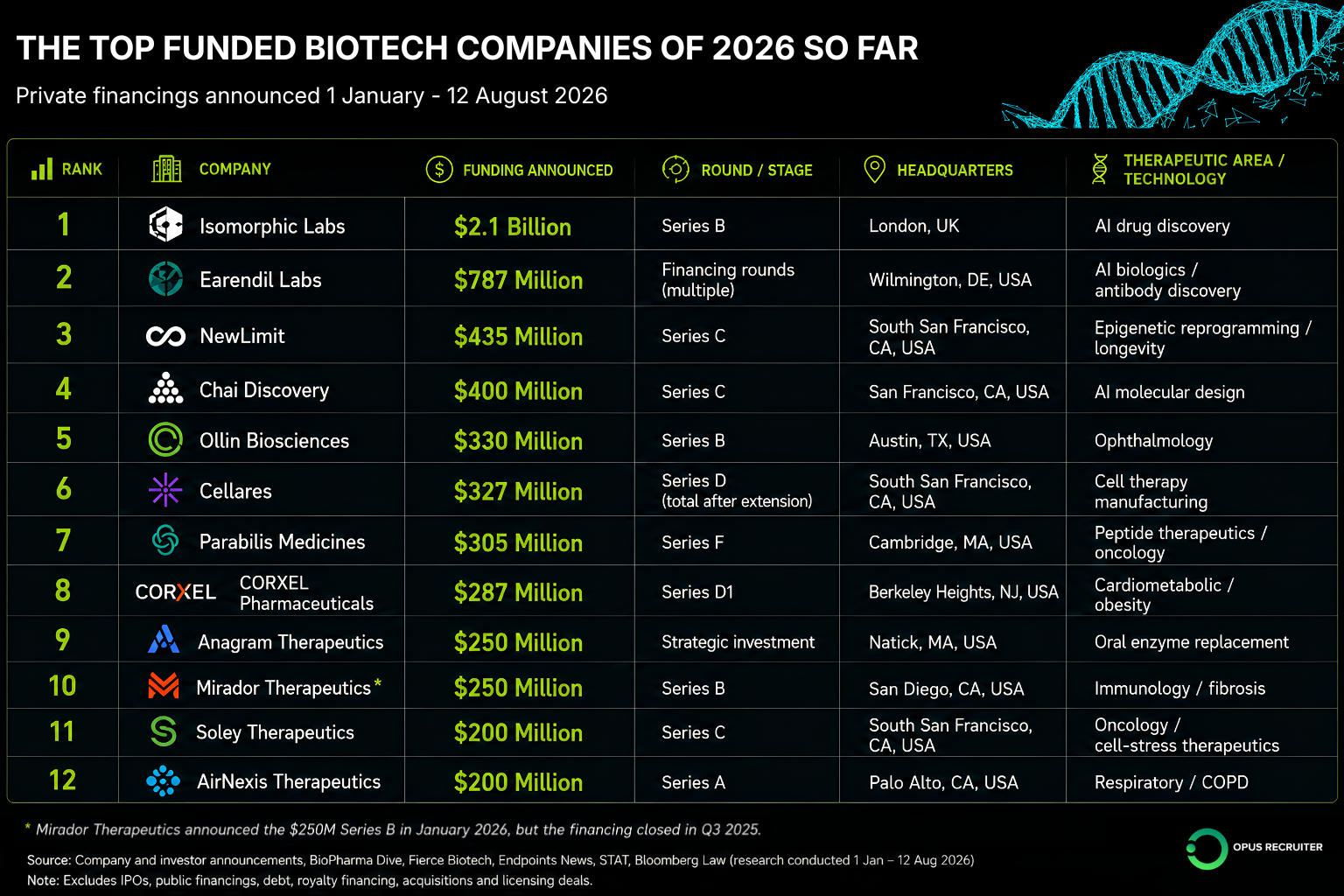
There are a few details worth knowing before comparing the numbers directly. Earendil's $787 million was described as "financing rounds", rather than a single conventional round. Cellares reached $327 million through an initial Series D and a later extension. Mirador announced its $250 million Series B in January 2026, although the financing had actually closed during Q3 2025.
So this is best read as a ranking of major private biotech financing announced in 2026, rather than 12 identical venture rounds.
1. Isomorphic Labs - $2.1 billion
Isomorphic Labs announced a $2.1 billion Series B in May, comfortably the largest financing on our list. Investors included Thrive Capital, Alphabet, GV, MGX, Temasek and CapitalG.
The London-based company is building AI systems for drug design, including technology derived from the work behind AlphaFold. The new capital will support development of its drug-design engine and its own pipeline of drug candidates.
The amount raised is what makes Isomorphic particularly interesting. Investors aren't funding a software tool that pharmaceutical companies might use alongside conventional discovery. Isomorphic is attempting to build an AI-led drug discovery operation capable of producing medicines itself.
At $2.1 billion, investors are putting a remarkable amount of capital behind that idea.
2. Earendil Labs - $787 million
Earendil Labs announced $787 million across financing rounds in March to expand its AI-driven biologics discovery and development work.
Biologics are medicines produced from, or designed around, biological molecules such as proteins and antibodies. Earendil uses AI to help design these molecules and has reported a pipeline of more than 40 programmes.
The $787 million shouldn't be read as a single conventional venture round because of the way the financing was structured. Even with that caveat, it is one of the year's largest biotech funding announcements.
3. NewLimit - $435 million
NewLimit raised a $435 million Series C for something quite different: trying to make ageing cells behave more like younger ones.
The South San Francisco company is developing therapies based on cellular reprogramming, which involves changing how genes behave inside a cell without changing the underlying DNA sequence. Its first programme is focused on restoring function in ageing liver cells.
Longevity research has attracted plenty of attention and ambitious claims over the years. A $435 million Series C gives NewLimit substantial capital to test whether cellular reprogramming can move from compelling biology towards medicines that work in people.
4. Chai Discovery - $400 million
Chai Discovery raised a $400 million Series C in July for its AI-based molecular design platform.
The San Francisco company uses AI to help design proteins and other molecules that could become medicines. Its investors include Index Ventures, Kleiner Perkins, Sequoia Capital, Thrive Capital and OpenAI, and the company has reported partnerships with pharmaceutical groups including Pfizer, Eli Lilly and Novartis.
Put Chai together with Isomorphic and Earendil and the scale becomes clearer: roughly $3.3 billion in announced financing across three AI-led drug and biologics discovery companies.
Around $3.3 billion went to Isomorphic Labs, Earendil Labs and Chai Discovery alone.
5. Ollin Biosciences - $330 million
Ollin Biosciences raised an oversubscribed $330 million Series B in June. Its lead programme, OLN324, is a bispecific antibody targeting VEGF and Ang2, two proteins involved in the abnormal blood-vessel growth associated with several eye diseases. Global Phase 3 development is planned in diabetic macular edema and wet age-related macular degeneration.
Ollin stands out among the companies above it because this is a more conventional therapeutic development story. Investors are backing a specific drug candidate approaching late-stage clinical development rather than a broad AI or discovery platform, and they are backing it with $330 million.
6. Cellares - $327 million
Cellares is tackling one of cell therapy's less glamorous but very real problems: manufacturing.
Personalised cell therapies can be difficult and expensive to produce because patient cells may need to be collected, processed, modified, tested and returned for treatment. Doing that reliably for increasing numbers of patients is a major operational challenge.
Cellares is developing automated manufacturing facilities it calls Smart Factories. The company announced a $257 million Series D in January and later added an extension, bringing the financing to $327 million.
Its important to note that Cellares isn't developing the therapeutic itself. It is building infrastructure intended to make other companies' cell therapies easier to manufacture at commercial scale.
The other companies above $200 million
The remaining seven financings cover a surprisingly broad range of biology.
Parabilis Medicines raised $305 million for its work on peptide-based medicines targeting proteins that have historically been difficult to drug.
CORXEL Pharmaceuticals raised $287 million, including funding for its cardiometabolic pipeline.
Anagram Therapeutics secured a $250 million investment from Blackstone Life Sciences to advance an oral enzyme replacement treatment. The idea is particularly interesting because enzyme replacement therapies are traditionally administered by injection or infusion.
Mirador Therapeutics announced a $250 million Series B for its work on immune-mediated inflammatory and fibrotic diseases.
CellCentric raised an oversubscribed $220 million Series D in May to advance inobrodib, its oral p300/CBP inhibitor for multiple myeloma.
At the $200 million mark, Soley Therapeutics is developing cancer treatments using its work on cellular stress, while AirNexis Therapeutics launched with a $200 million Series A to develop AN01 for chronic obstructive pulmonary disease (COPD).
The variety here matters. Once we move beyond the enormous AI financings at the top, there isn't one therapeutic area swallowing all the capital.
Where is the money going?
AI is the obvious standout.
Isomorphic, Earendil and Chai account for roughly $3.3 billion between them. More importantly, investors are backing companies that want AI to sit much closer to the centre of drug discovery, rather than simply selling software into pharmaceutical R&D.
But look further down the ranking and the picture becomes more varied.
NewLimit is pursuing cellular reprogramming. Ollin is taking an antibody towards Phase 3 development. Cellares is building manufacturing infrastructure. Anagram is working on oral enzyme replacement. AirNexis is developing a COPD treatment.
That suggests investors aren't simply looking for whichever company can put "AI" in its pitch deck. Large amounts of capital are still available where investors see a strong drug candidate, an interesting piece of biology or a genuine bottleneck in how medicines are developed and produced.
There are also notable companies just below our $200 million cutoff. Element Biosciences, for example, announced an upsized Series E in June that included a $175 million investment from Samsung Electronics. That is a different type of bet again: infrastructure for sequencing, genomics and multiomics rather than therapeutics.
And we're only in August
This ranking covers announcements through 12 August 2026. A single large financing could change the top of the table before the year is finished.
What is already clear is how concentrated the very largest deals have become. Isomorphic alone accounts for more capital than several of the companies lower down the ranking combined, while three AI-led discovery companies account for approximately $3.3 billion.
Below them, the money spreads across a much wider range of technologies and diseases.
That makes the second half of 2026 worth watching. The interesting question isn't simply whether biotech funding increases or decreases. It's whether investors continue concentrating the biggest cheques around AI-led discovery, or whether another area of biotech starts producing deals on the same scale.