
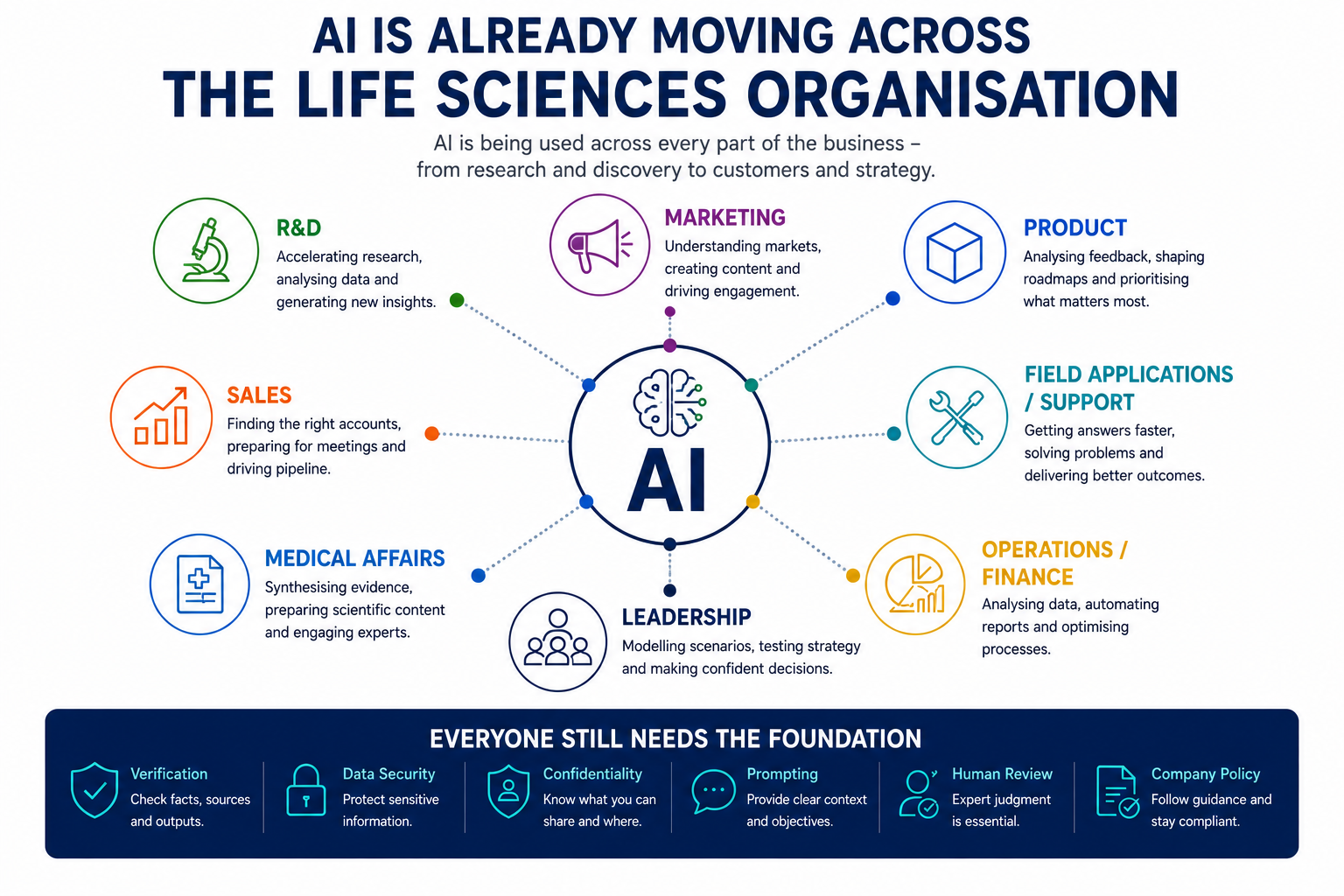
AI is already moving through Life Sciences organisations, whether every company has a formal AI strategy or not.
Scientists are using it to search and interrogate literature, analyse datasets, explore hypotheses and accelerate parts of experimental planning. Sales teams can use AI-enabled prospecting platforms to identify better-fit companies and decision-makers, research accounts before approaching them, prepare for meetings and analyse what is happening across their pipeline. Marketing teams are using it for market research, competitor intelligence, campaign development, copywriting, editing, SEO, content repurposing, image generation and increasingly sophisticated creative work.
Product teams can pull together customer interviews, sales feedback, support tickets, competitor announcements, pricing information, reviews and public discussions to identify patterns that would be difficult to spot manually. Field Applications teams can search technical documentation, investigate unfamiliar workflows and prepare for customer visits. Medical Affairs can accelerate evidence searches and scientific preparation. Operations can analyse processes and automate repetitive work. Senior leaders can interrogate reports, research markets, model scenarios and challenge strategic assumptions.
And this is still developing remarkably quickly.
The interesting question is therefore no longer whether employees are going to use AI. Many already are.
The question for leaders is whether they understand where it genuinely improves the work, which tools belong where, what needs to be checked and where human judgement still needs to take over.
AI literacy isn't only becoming a technical skill. It's becoming part of how Life Sciences companies operate.
1. Start with the work, not the AI
Every time a new model appears, there is a temptation to start looking for somewhere to use it. A better starting point is the work people are already doing.
Where are teams spending hours searching for information? Where is knowledge fragmented? Which repetitive tasks consume time? Where are people trying to make sense of more information than they can realistically process manually?
A scientist might need to search years of literature. A salesperson may need to work out which 50 companies in a market are actually worth approaching. A Product Manager could have customer feedback scattered across CRM records, support tickets and interviews. A marketer might need to compare the positioning and activity of 20 competitors.
AI can help with all of these, but not necessarily through the same tool. Sales intelligence platforms can find and enrich prospective accounts. Other platforms can automate outreach. General-purpose models can support research and analysis, while specialist tools can interrogate scientific literature, generate creative assets, analyse datasets or search internal company knowledge.
AI literacy isn't simply knowing how to use ChatGPT. It's understanding which tools and workflows actually make the work better.
The underlying information still matters. Benchling's 2026 Biotech AI Report found that 55% of surveyed organisations identified poor data quality and availability as the leading reason AI pilots fail. [1]
A badly maintained CRM doesn't suddenly produce great commercial intelligence because AI has been added.
Better models don't automatically create better inputs.
2. Sales could change considerably more than writing follow-up emails
When people talk about AI in sales, the examples are often fairly basic: writing emails, summarising calls or creating meeting notes. The bigger opportunity starts much earlier in the commercial process.
AI-enabled sales intelligence platforms can help teams identify companies matching an ICP, find the relevant people inside them and research the signals that make an account worth approaching. For a sequencing company, that could mean finding laboratories expanding their genomics capabilities or hiring into particular applications. A CRO might identify biotechs moving programmes towards clinical development.
That research can feed directly into outreach. Parts of the workflow can now be connected: find the account, identify the right people, research the opportunity, personalise the message, run the outreach and track the response.
The value isn't in automating 5,000 generic emails. It's being able to identify 200 genuinely relevant accounts and approach them with a reason that makes sense.
Once somebody responds, AI can support meeting preparation, account history, call notes, follow-ups and CRM administration. The salesperson still has to understand the customer, ask good questions, build credibility and move the opportunity forward; they're simply spending less time on the manual work around it.
Poor targeting combined with automation just creates more spam, while inaccurate account research can damage a customer conversation. Commercial teams need to understand what can be automated, what should be personalised and what needs to be checked.
3. Marketing has an enormous production engine. That isn't automatically a good thing.
Marketing is probably one of the easiest places to see how much broader AI has become. Teams can investigate markets, customers, competitors, search behaviour and emerging trends much faster than before. It can support campaign development, audience research, copywriting, editing, SEO, content repurposing, translation and campaign analysis.
Creative production is changing too. Images can be generated and refined, backgrounds changed, concepts visualised and existing assets adapted for different campaigns and channels. A relatively small marketing team can now research, create and iterate at a level that previously required considerably more time or external resource.
But there is another side to this. As AI increases what Marketing can produce, expectations of Marketing are increasing with it.
More campaigns. More content. More channels. More personalisation. Faster turnaround. More markets being supported. In some companies, that expectation is arriving without additional headcount, investment in the right tools or proper training in how to use them.
Simply giving a team access to an AI model doesn't suddenly create an AI-enabled marketing function. The quality of the tools matters, as does training people to use them properly and building workflows around the work. And while AI can make the first stage of production much faster, somebody still has to review the science, refine the message, check the sources, protect the brand and decide whether the output is actually good.
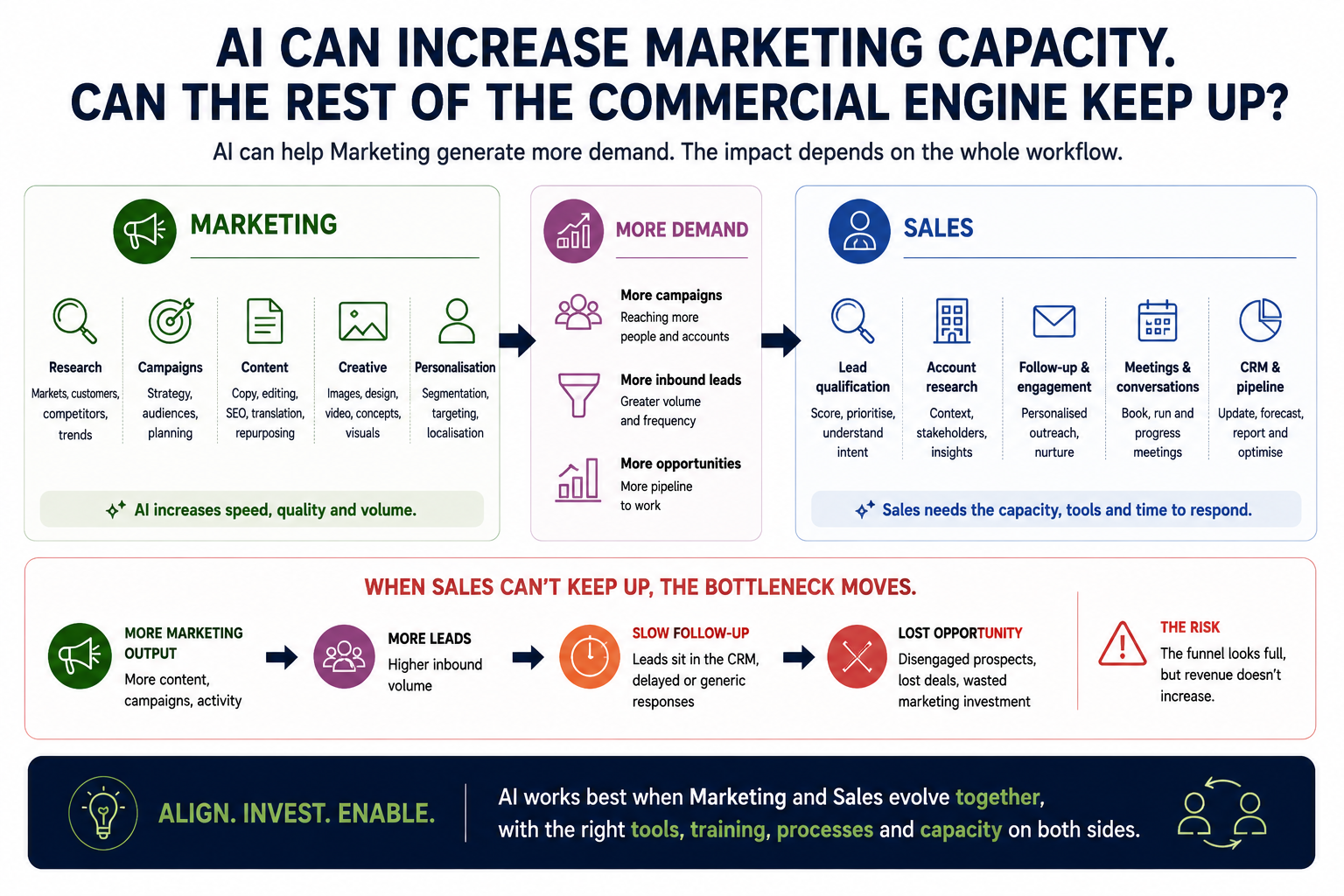
There is also a knock-on effect across the commercial organisation. If Marketing can run more targeted campaigns and generate more inbound demand, Sales has to be able to keep up with the leads coming in. There is little value in increasing lead generation if good prospects then sit untouched in the CRM for days. AI can help Sales qualify and prioritise those leads, research the accounts and prepare more relevant follow-up, but that only works if the commercial workflow develops alongside Marketing.
And greater output doesn't automatically mean better marketing. A model can write a technically convincing article while misunderstanding the science, build a competitor comparison around outdated information or turn a qualified study result into a stronger claim than the evidence supports. It can create a beautiful scientific image that is biologically nonsensical, or fifty polished social posts that nobody particularly wants to read.
Good marketers don't become less important because production gets easier. Somebody still needs to understand the market and customer, recognise weak ideas, know what is worth saying and take responsibility for what eventually goes out.
AI can increase Marketing's capacity considerably. The challenge is making sure the tools, training, quality control and the rest of the commercial organisation can keep up.
For a Marketing Director, that's a much more important question than simply telling the team to “use AI to create more content.”
4. Product teams can listen to far more of the market
Product teams have always had a difficult information problem. Customer insight rarely arrives neatly. It sits in Product Manager interviews, CRM notes, Field Application reports, sales conversations, support tickets, distributor feedback, lost opportunities, competitor announcements, conference conversations, Reddit threads, reviews, pricing changes and countless other places.
AI makes it increasingly practical to analyse larger volumes of this unstructured information. A Product Manager could potentially identify recurring customer complaints, cluster feature requests, compare feedback by segment, monitor changes in competitor positioning or investigate why customers are choosing one workflow over another.
Public information adds another layer. Competitor websites, product launches, price lists, publications, conference presentations, job advertisements and public customer discussions can all contribute to a better picture of where a market is moving.
This doesn't mean asking AI:
What product should we build next?
The value is helping the Product Manager see more of the evidence before making that decision. AI expands what can be analysed. It doesn't decide what matters.
5. Customer-facing scientific teams can arrive better prepared
A Field Application Scientist visiting a laboratory may need information from previous support cases, instrument history, protocols, application notes, customer correspondence and technical documentation.
An effective internal AI knowledge system could pull that information together before the visit, identify similar cases and help the FAS prepare the right questions. During troubleshooting it can support information retrieval, and afterwards help structure the case so the next person doesn't start from zero.
Medical Affairs has different workflows but a similar information problem across literature surveillance, evidence synthesis and scientific preparation.
The value isn't replacing the expertise of these teams. Their expertise is what allows them to recognise whether the information AI retrieves actually makes sense.
6. AI needs to be challenged, not simply used
One of AI's more dangerous abilities is sounding certain when it is wrong. A 2026 study into AI-assisted medical decision-making found that incorrect AI outputs could negatively affect physicians' diagnostic accuracy. [2] The lesson extends well beyond diagnosis.
A Commercial Director receives a convincing explanation for falling pipeline conversion. Is it actually supported by the data? A Product Manager asks for competitor pricing. Is it current? A marketer summarises a clinical study. Did the model preserve the limitations?
AI literacy includes developing the habit of asking: Where did this come from? What supports it? What might be missing? How current is it? What needs checking before I act on it?
FDA and EMA principles for good AI practice in drug development similarly emphasise human-centric design and multidisciplinary expertise. [3]
AI can contribute to the decision. Somebody still owns the decision.
7. AI doesn't remove a leader's responsibility to understand their own work
There is a particularly poor version of AI adoption appearing in management: asking ChatGPT, Claude or another model to produce a strategy, copying the output into a document and sending it to a team to execute.
Using AI to develop strategy isn't the problem. It can be excellent for researching markets, comparing competitors, exploring scenarios, challenging assumptions and finding gaps in your thinking.
The problem starts when the leader stops doing the thinking.
An AI-generated strategy can contain outdated information, misunderstand the market or make assumptions that simply don't apply. None of that prevents it from producing an immaculate 20-page document.
If you're putting your name behind a strategy, you should be able to explain it. Why this market? What evidence supports the recommendation? What assumptions have been made? What alternatives were considered?
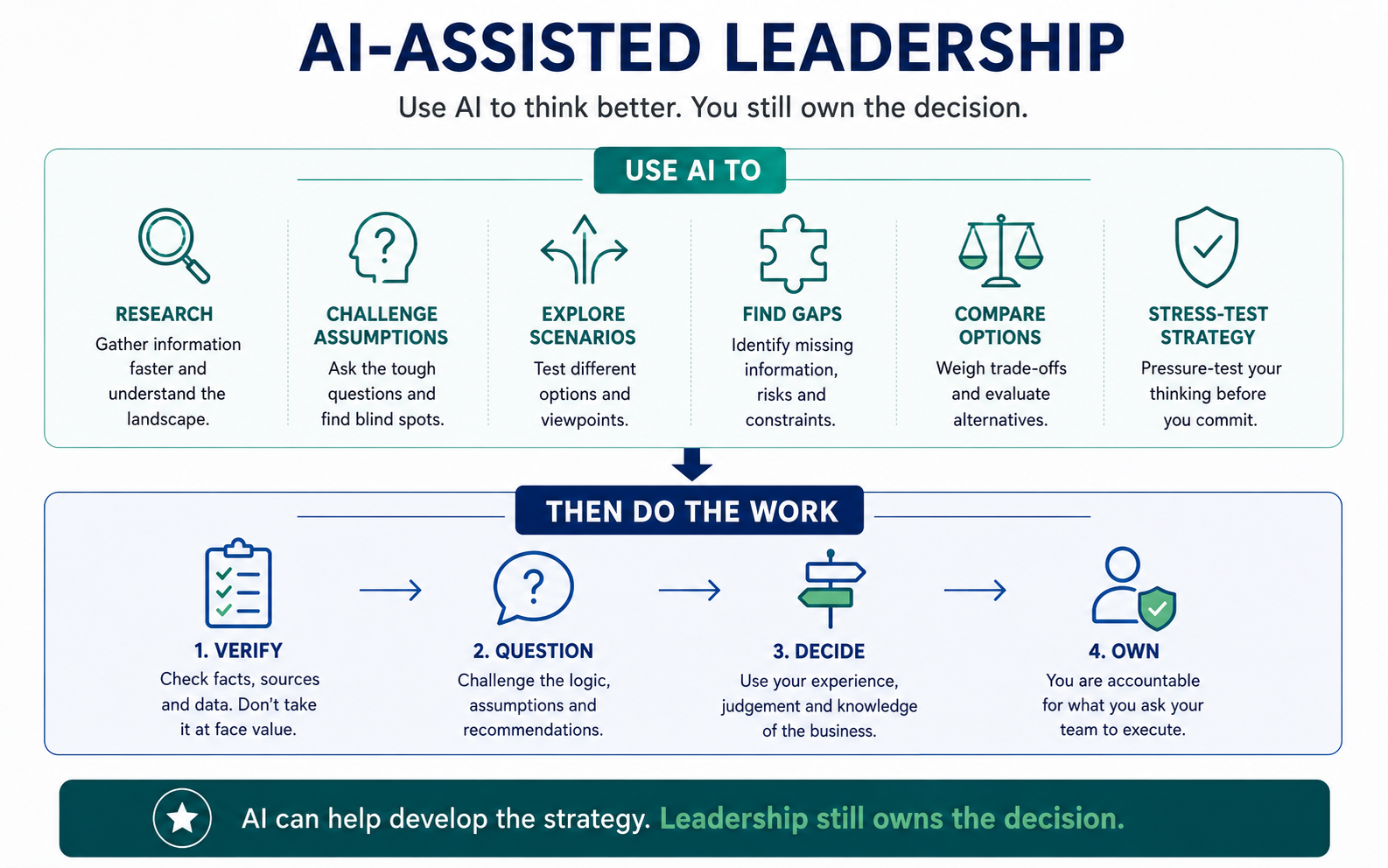
If the team asks those questions and the person who handed them the strategy can't answer because they haven't properly reviewed it, AI hasn't improved leadership.
It has simply made poor leadership faster.
AI can help you think. It cannot take responsibility for what you ask other people to execute.
Use it to challenge the strategy instead. Ask what you're missing. Make it argue against your preferred option. Check important claims against primary sources. Change assumptions and see whether the recommendation still holds.
A strategy developed with AI can be excellent. A strategy outsourced to AI is something else entirely.
8. In R&D, faster thinking can simply move the bottleneck
Scientists can already use AI across literature discovery, coding, data interrogation, experimental planning and biological design. In antibody discovery, for example, computational approaches can explore candidate designs at a scale that would have been impractical through conventional experimental iteration alone. [4]
Eventually, somebody still has to test them.
Candidates need to be synthesised, expressed, screened and validated. Cells don't divide faster because the computational work upstream took 30 seconds.
In 2026, OpenAI and Ginkgo Bioworks connected GPT-5 with laboratory automation in a closed-loop protein-production experiment. The system proposed experiments, executed them, analysed the results and iterated across six rounds, with OpenAI reporting an approximately 40% reduction in protein production cost. [5]
The interesting part was the connection between computational reasoning and physical experimentation.
If AI allows an R&D team to identify twice as many experiments worth pursuing, can the laboratory actually run them?
As biological design becomes faster, the ability to validate those ideas in the real world may become more valuable, not less.
9. The performance gap may appear between people doing the same job
The immediate effect of AI may not be that entire jobs disappear. It may be that two people doing the same job start working very differently.
Take two Life Sciences salespeople. One manually builds prospect lists, researches companies, prepares for meetings and updates the CRM. The other uses approved AI-enabled tools to identify better-fit accounts, research buying signals, prepare meetings, retrieve internal knowledge and reduce administration.
They both still sell. They still make the calls, build relationships, negotiate and exercise commercial judgement.
But the work surrounding those activities is completely different.
The same could apply to marketers, scientists, Product Managers, recruiters or Field Application Specialists.
That doesn't mean the person using the most AI wins. Blindly trusting it can make somebody worse at their job remarkably quickly.
The useful skill is knowing what to delegate to AI and what not to delegate. Benchling found that among the AI-active organisations it surveyed, 67% were building capability by upskilling existing scientists. [1]
That makes sense. Domain expertise is often exactly what allows somebody to recognise when the model is wrong.
10. Every department needs AI training. They do not need the same AI training.
A two-hour presentation on generative AI and ten prompting techniques doesn't make a workforce AI literate.
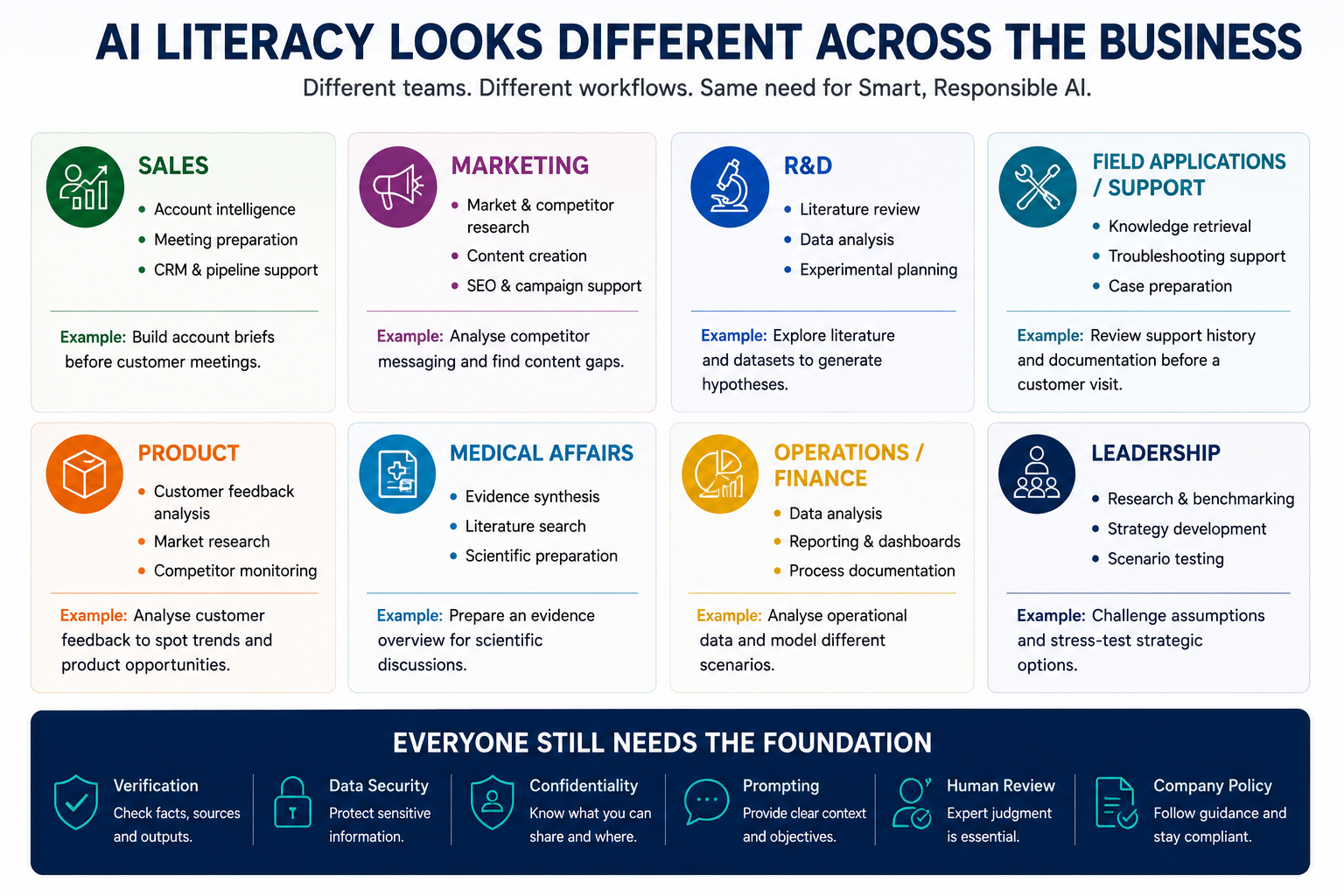
A salesperson, computational biologist, marketer, Product Manager and Field Application Scientist work with different information and make different decisions. Their training should reflect that.
There is a common foundation: verification, data security, confidentiality, intellectual property, company policy, prompting and human review.
After that, training needs to connect to the actual job.
Sales teams need to understand prospecting, research, outreach automation and customer data. Marketing needs research, content and creative workflows alongside scientific accuracy and IP. Product teams need customer and competitive intelligence. R&D needs scientific tools, data and experimental workflows. Field Applications needs technical knowledge retrieval and troubleshooting. Leadership needs research, scenario analysis, critical review and enough understanding to challenge the work being produced.
And one tool isn't necessarily enough.
General-purpose models such as ChatGPT, Claude and Gemini overlap considerably, but specialist platforms can solve different problems. Sales intelligence tools can support prospecting. Scientific platforms can improve literature discovery. Image models support creative production. Automation platforms connect workflows. Internal knowledge systems make company information easier to interrogate.
Knowing how to prompt matters. Knowing what tool belongs where may matter more.
Context beats clever prompting
Compare:
Create a commercial strategy for our sequencing business in Germany.
with:
We sell a benchtop sequencing platform into German academic and clinical research laboratories. Here is our customer segmentation, installed base, competitor information and 2026 commercial objective. Identify three possible growth strategies. For each, show the evidence, assumptions, missing information and the main reason it could fail.
The second isn't better because of a secret prompting technique. It's better because the model has context, a defined problem and instructions to expose weaknesses in its reasoning.
That is a much more useful skill than memorising a list of “power prompts.”
So what does AI literacy actually mean for a Life Sciences leader?
It doesn't mean becoming an AI expert or understanding how every model works. It means understanding enough to decide where AI genuinely improves the work, which tools are appropriate, what information can safely be shared, what needs verification and where human judgement needs to take over.
It also means recognising that AI capability can't sit with one department. The opportunity in R&D is different from Sales; Marketing needs different skills from Field Applications; Product, Medical Affairs, Operations and leadership all have their own workflows.
That requires training, but not generic training. It also requires boundaries around confidential data, customer information, intellectual property and scientific accuracy.
And leadership has to set the standard. If a leader uses AI to develop a strategy, they still need to understand it. If a team uses AI to produce customer-facing work, somebody still owns its accuracy. If AI contributes to a decision, the model doesn't become accountable for the outcome.
AI literacy isn't about how much work you can hand over to AI. It's about knowing how to use it to do your own work better.
For Life Sciences companies, that capability will matter far beyond the laboratory. It will influence how companies discover drugs, find customers, understand markets, develop products, support laboratories and make decisions.
Building your team, or thinking about your next move?
AThe skills Life Sciences companies need are changing. At Opus Recruiter, we work with organisations and professionals across scientific, commercial and leadership roles to find the people who can move with that change.
Hiring in Life Sciences?
Find out how Opus Recruiter supports Life Sciences hiring
Exploring your next opportunity?
Browse our latest opportunities or connect with the Opus team.
Sources
1. Benchling — 2026 Biotech AI Report
AI adoption, data-quality barriers and workforce upskilling in biotech.
Benchling — 2026 Biotech AI Report
2. Strickland, M. & Kuziemko, C. — When AI is wrong: the limits of human oversight in AI-assisted diagnostic decision-making
Behaviour & Information Technology (2026). Research examining the effect of incorrect AI recommendations on human diagnostic decision-making.
Read the study
3. FDA & EMA — Guiding Principles of Good AI Practice in Drug Development
Principles covering human-centric design, multidisciplinary expertise, data governance and responsible AI use in drug development.
FDA — Guiding Principles of Good AI Practice in Drug Development
4. Cha, M. & Kim, H. M. — Artificial Intelligence-Driven Computational Methods for Antibody Design and Optimization
mAbs (2025), 17(1), 2528902. Review of AI-driven computational approaches to antibody design and optimisation.
Read the study
5. OpenAI & Ginkgo Bioworks — GPT-5 lowers protein synthesis cost
Research connecting GPT-5 with laboratory automation in a closed-loop protein-production optimisation experiment.
OpenAI — GPT-5 lowers protein synthesis cost