
You can have a PhD, years of postdoctoral research, publications, conference presentations and deep expertise in your field. Then you open an industry job description and see:
“3+ years of industry experience required.”
A slightly inconvenient requirement when you're trying to get your first industry job.
But there is another mistake people make at this point. They assume that moving into industry means finding the closest corporate equivalent of their academic position.
It doesn't have to.
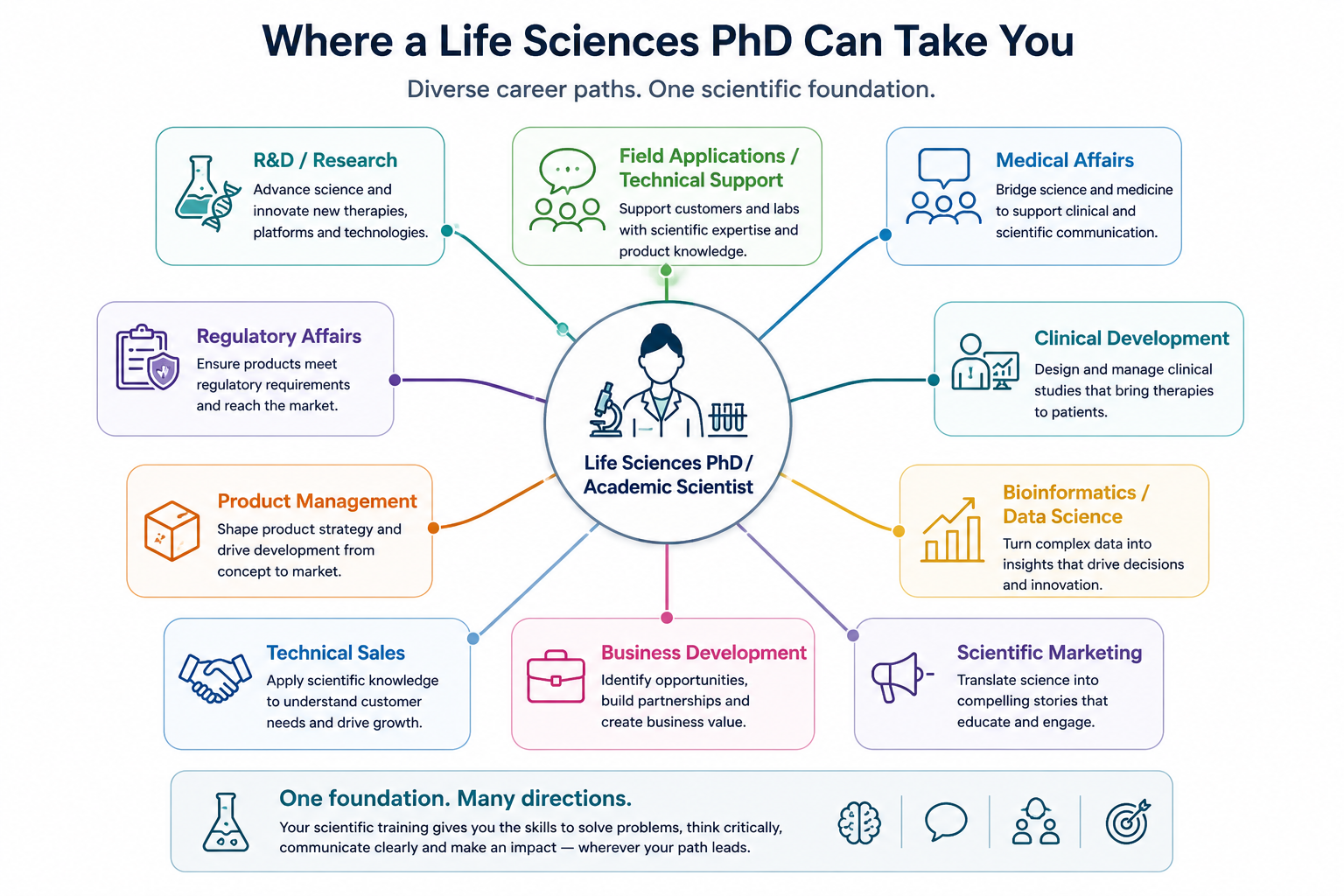
Life Sciences companies employ scientists in R&D, but they also need bioinformaticians, application scientists, product managers, medical affairs professionals, scientific marketers, regulatory specialists, technical salespeople, business development managers and many other people who started their careers in science.
So before worrying about whether your academic experience “counts”, there is a more useful question to answer:
Where in industry do you actually want to go?
Already preparing for an industry interview?
If you're already applying or interviewing, we've also put together our Top 10 Life Sciences Interview Tips, covering company research, preparing examples, the questions worth thinking about beforehand and how to communicate your experience clearly.
1. Start with the role, not with “industry”
One of the easiest mistakes to make is deciding you want to “leave academia and go into industry” without deciding what you actually want to do there. There are hundreds of possible roles.
Consider someone completing a PhD in molecular biology. They might be technically qualified for an R&D Scientist position, but that doesn't necessarily mean R&D is the best career for them.
If they enjoy explaining technology and working with other scientists, Field Applications might suit them better. Someone fascinated by why one technology succeeds commercially while another doesn't might enjoy Product Management. Someone who enjoys building relationships and doesn't mind commercial targets could consider Technical Sales or Business Development.
Other scientists may want to remain much closer to research through R&D, assay development, Clinical Development or bioinformatics.
There are also careers in:
R&D and assay development
Bioinformatics and data science
Field Applications and technical support
Medical Affairs
Clinical Development
Regulatory Affairs
Product Management
Scientific and Product Marketing
Technical Sales
Business Development and partnerships
Scientific communications
Project and programme management
These jobs require different personalities, skills and experience. Applying indiscriminately to all of them usually makes the transition harder because your CV and interview story never become particularly convincing for any one of them.
Before rewriting your CV, spend some time deciding what you actually want your working day to look like.
Do you want to stay at the bench? Work with customers? Analyse data? Travel? Build products? Explain science? Work commercially? Manage programmes?
Those questions are often more useful than simply asking which jobs accept a PhD.
2. Learn what the job actually involves
Once you have identified a few possible directions, investigate them properly. Job titles can be misleading. A Product Manager at a sequencing company may have a very different job from a Product Manager at a pharmaceutical company. A Field Application Scientist covering Europe may spend a significant amount of time travelling, while another applications role could be largely office or remotely based.
Read 15 or 20 job descriptions for the type of role you are considering. Don't worry about applying yet. Look for patterns.
What responsibilities keep appearing? Which skills are consistently requested? Which technologies are mentioned? Does the role involve customers? Is commercial experience expected? Are there regulatory requirements? How much travel is involved?
Then speak to people actually doing the job. Ask them what they spend most of their week doing, what surprised them about the role and which skills they use most often. You will learn considerably more from a few good conversations than you will from trying to infer an entire profession from job advertisements.
This also prevents a common problem: spending months trying to get into a career only to discover that you don't particularly enjoy the work.
3. Your academic experience can be useful, but translate it properly
Academic CVs and industry CVs are written for different audiences. An academic hiring panel may care about your publication record, thesis topic and detailed methodology. An industry hiring manager may care much more about what you can do.
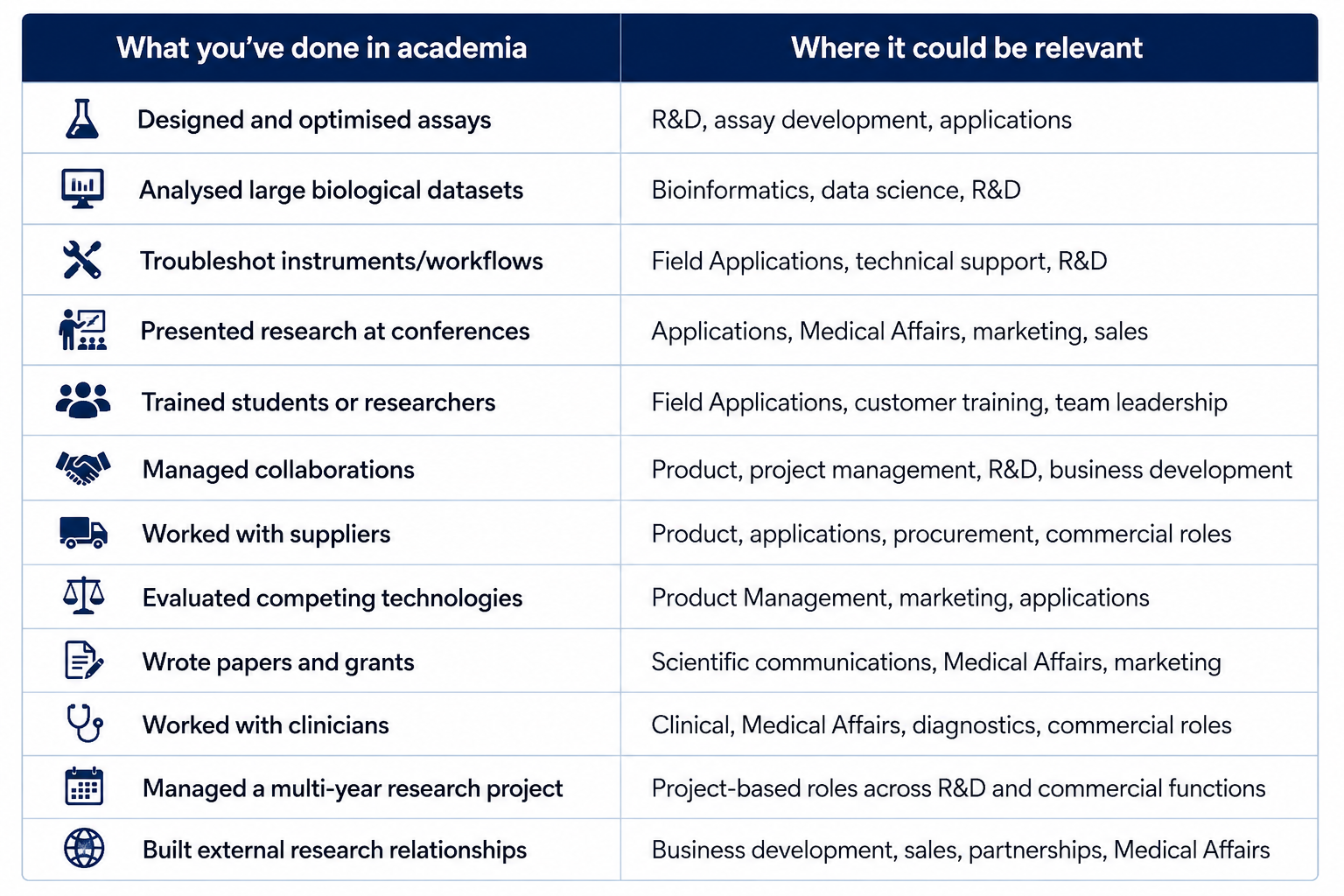
Suppose you spent four years developing and optimising an assay.
The technical details matter if you're applying for an assay-development position. For an applications role, however, the more interesting part may be that you optimised a difficult workflow, identified failure points and trained other researchers to use it.
For Product Management, perhaps you evaluated competing technologies and worked with suppliers. For a commercial position, maybe you presented research internationally, built external relationships or persuaded collaborators to support a project.
The underlying experience hasn't changed. What matters is which part of it is relevant to the job in front of you.
A few examples make the point:
This doesn't mean you should simply rename academic activities using corporate terminology. Hiring managers can see through that very quickly.
The objective is to explain what you actually did, what you were responsible for and why that experience matters for their role.
4. Be realistic about the gaps
Transferable skills matter, but there is a danger in taking the idea too far. Completing a PhD does not automatically make someone an experienced Product Manager because they managed a research project. Presenting at conferences doesn't automatically give someone commercial sales experience. Publishing papers isn't the same as developing a marketing strategy.
You don't need to pretend otherwise. Instead, compare yourself against the role.
If you want to become a Field Application Scientist, perhaps your scientific background, instrument experience, troubleshooting and training experience already give you a strong starting point.
If you want to move into Technical Sales, your scientific credibility may be valuable, but you might know very little about prospecting, account management, negotiation, forecasting or commercial targets.
A future Product Manager might need more exposure to customers, competitor analysis, market research, product positioning and commercial decision-making.
Someone targeting Medical Affairs may need to understand the pharmaceutical development environment, evidence generation, compliance requirements and how Medical Affairs interacts with clinicians and internal teams.
Different transitions have different gaps. Identify yours specifically. Once you know what's missing, you can start doing something about it.
5. Don't wait for your first industry job to start building industry-relevant experience
This is particularly important if you're still completing a PhD, postdoc or research position.
You may not have direct industry experience yet. That doesn't mean the only thing you can do for the next three years is research.
Do other things.
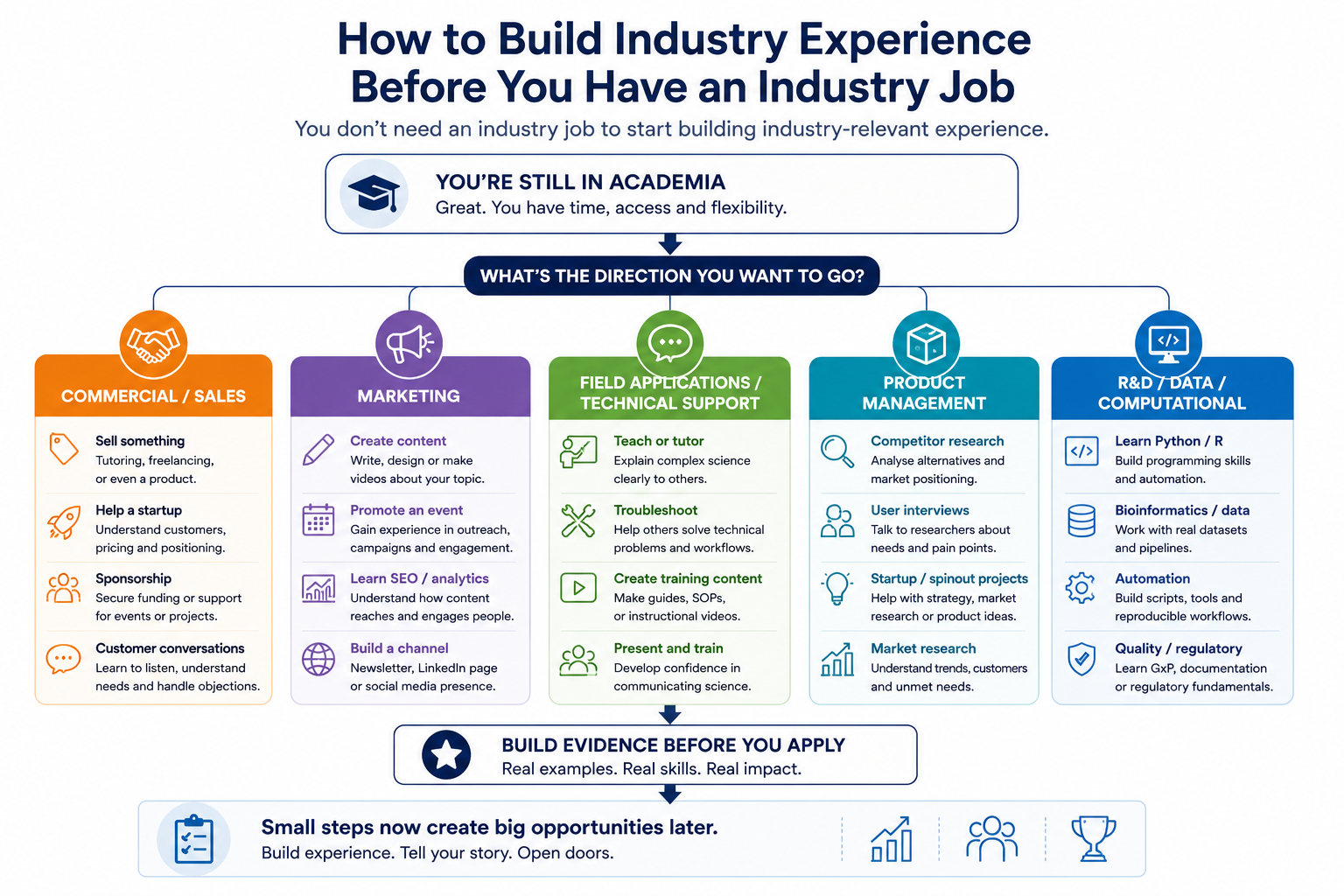
If you're interested in marketing, help promote a conference, build a scientific social media account, write articles, learn basic SEO, create educational videos or help a university spinout with its content.
If you're interested in sales or Business Development, find opportunities that force you to sell something. Help secure sponsorship for an event. Tutor privately. Freelance. Support a startup. Get involved in conversations where you have to understand what somebody needs and convince them of the value of what you're offering.
If Field Applications interests you, teach. Train students. Create technical guides. Help other researchers troubleshoot workflows. Volunteer to demonstrate equipment or train new laboratory members.
Someone interested in Product Management could help a startup or university spinout with competitor research, interview potential users, analyse a market or become involved in commercialisation activities.
For computational careers, build something. Learn Python or R properly. Work with public datasets. Automate part of your workflow. Contribute to a project where someone else will actually use what you've created.
Consulting projects, societies, entrepreneurship programmes, university technology-transfer offices and student organisations can also provide useful opportunities.
None of these activities magically gives you three years of industry experience. What they give you is evidence. Evidence that you've explored the career seriously. Evidence that you've developed skills beyond your immediate research project. And, importantly, examples you can actually discuss when an interviewer asks what you've done outside your PhD.
The candidate who has spent four years doing excellent research may be strong.
The candidate who has done excellent research and built relevant experience around it can be much easier for an employer to picture in the role.
6. Rewrite your CV for the job you want
Sending an academic CV to an industry employer and hoping they work out how your experience translates is rarely a good strategy. Start with the job description. If the company wants someone who can troubleshoot NGS workflows, train customers and communicate complex technical information, those capabilities should be easy to find on your CV. Don't bury them beneath a full list of publications.
For a commercial position, your CV might give more prominence to customer interaction, external partnerships, presentations, supplier relationships and examples where you influenced decisions.
For bioinformatics, the technical stack, datasets, pipelines, analytical methods and projects may deserve much more space.
For Medical Affairs, scientific communication, clinical exposure, KOL interaction and therapeutic-area expertise may become more important.
For Product Management, you might emphasise technology evaluation, cross-functional projects, market understanding and interaction with users or suppliers.
You are not creating different versions of yourself. You are deciding which parts of your experience matter most to a particular employer. And be careful with academic language. A hiring manager shouldn't need to understand your thesis before they can understand why you're useful.
7. Research the company beyond the About page
This is one of the simplest ways to distinguish yourself, and surprisingly few candidates do it properly. If you're interviewing with a genomics company, don't stop after memorising the names of its sequencing platforms.
Look at what the company actually sells, who buys it and which applications it supports. Look at recent launches, partnerships and announcements. Understand its major competitors. If it has recently entered a new market or launched a new product, think about why.
For a biotech company, look at the pipeline. Which programmes are furthest advanced? What indications are being targeted? What has happened recently? Has the company raised money, entered a partnership, reported clinical data or changed strategic direction?
Then bring that understanding into the interview naturally. A candidate who can discuss the company's actual business is much more convincing than someone whose preparation consists of:
“I saw on your website that you're an innovative company with a passion for improving patient outcomes.”
Anyone can say that.
Show that you were curious enough to understand the business you're asking to join.
8. Prepare interview examples for the job you're trying to get
Your first industry interview may feel unfamiliar because the questions often go beyond your scientific expertise. You may be asked about dealing with difficult stakeholders, managing competing priorities, influencing someone, handling failure, learning something quickly or making a decision without having perfect information.
Prepare examples before the interview.
If you're targeting Field Applications, think about times you troubleshot a technical problem, trained somebody, explained a complicated concept or dealt with a frustrated user.
For Product Management, prepare examples involving prioritisation, competing technologies, collaboration and decisions where several people wanted different things.
For sales or Business Development, think about persuasion, relationship building, handling objections and situations where you had to understand what another person actually needed.
For R&D roles, technical depth may carry more weight, but employers may still want evidence that you can work in teams, deliver against timelines and respond when experiments or projects don't go according to plan.
Don't memorise ten polished speeches. Know your own examples well enough that you can adapt them to the question.
Preparing for interviews? Read our Top 10 Life Sciences Interview Tips for a more detailed breakdown of what to prepare and how to approach the conversation.
You are not starting again
Moving from academia into industry can sometimes feel like starting your career again. It isn't. You already have experience. The task is working out which parts are relevant to the career you want, how to communicate them, and where you still need to build something new.
Some of that experience will transfer almost directly. A bioinformatician may already have many of the technical skills required for an industry role. A researcher moving into Field Applications may have years of experience troubleshooting workflows and training other scientists. Someone targeting Product Management or Technical Sales may have further to go on the commercial side, which is exactly why building experience outside academia matters.
The mistake is going too far in either direction. Don't try to convince an employer that your PhD was secretly five years of pharmaceutical industry experience. It wasn't. But don't behave as though those years gave you nothing useful either.
Work out what kind of career you actually want. Understand what people in that career do. Look critically at what you already bring, identify what's missing, and then do something about those gaps.
If you're still in academia, you have time to start now. Tutor someone. Learn to sell. Help a startup. Build something. Create content. Learn a complementary technical skill. Speak to people already doing the job.
By the time you submit your first serious industry application, your story should be stronger than:
“I have a PhD and I'd like to try something different.”
You want to be able to show why you've chosen this direction, what you already bring to it, and what you've done to prepare yourself for it.