

Life sciences interviews can be difficult to prepare for because there isn't really one type of life sciences interview.
A Research Scientist may be asked to troubleshoot an experiment. A Field Application Scientist might need to explain a complex technology to a customer. A Key Account Manager could be challenged on how they would develop a territory, while someone interviewing for a leadership role may spend considerably more time discussing strategy, people and decision-making.
The roles are different, but there is a common thread.
Companies increasingly want evidence that you can do the job, not simply evidence that you've held a similar title before. Current hiring guidance points towards greater emphasis on practical capability, measurable outcomes, technical assessments and cross-functional experience.
That changes how you should prepare.
Here are ten things worth thinking about before your next interview.
1. Know the science - but know when to simplify it
Technical knowledge matters, particularly in biotech, pharma, genomics, diagnostics and MedTech. But being technically strong doesn't mean giving the most complicated answer possible.
A good candidate can explain the science at the right level for the person sitting across from them.
If you're speaking to another scientist, that might mean going deep into methodology, controls or experimental design. If you're speaking to a commercial leader, customer or executive, the more useful skill may be explaining why the science matters.
Knowing the science is important. Knowing your audience is just as important.
2. Research the company beyond its homepage
Most candidates will read the About page. You can go further without spending three days conducting due diligence.
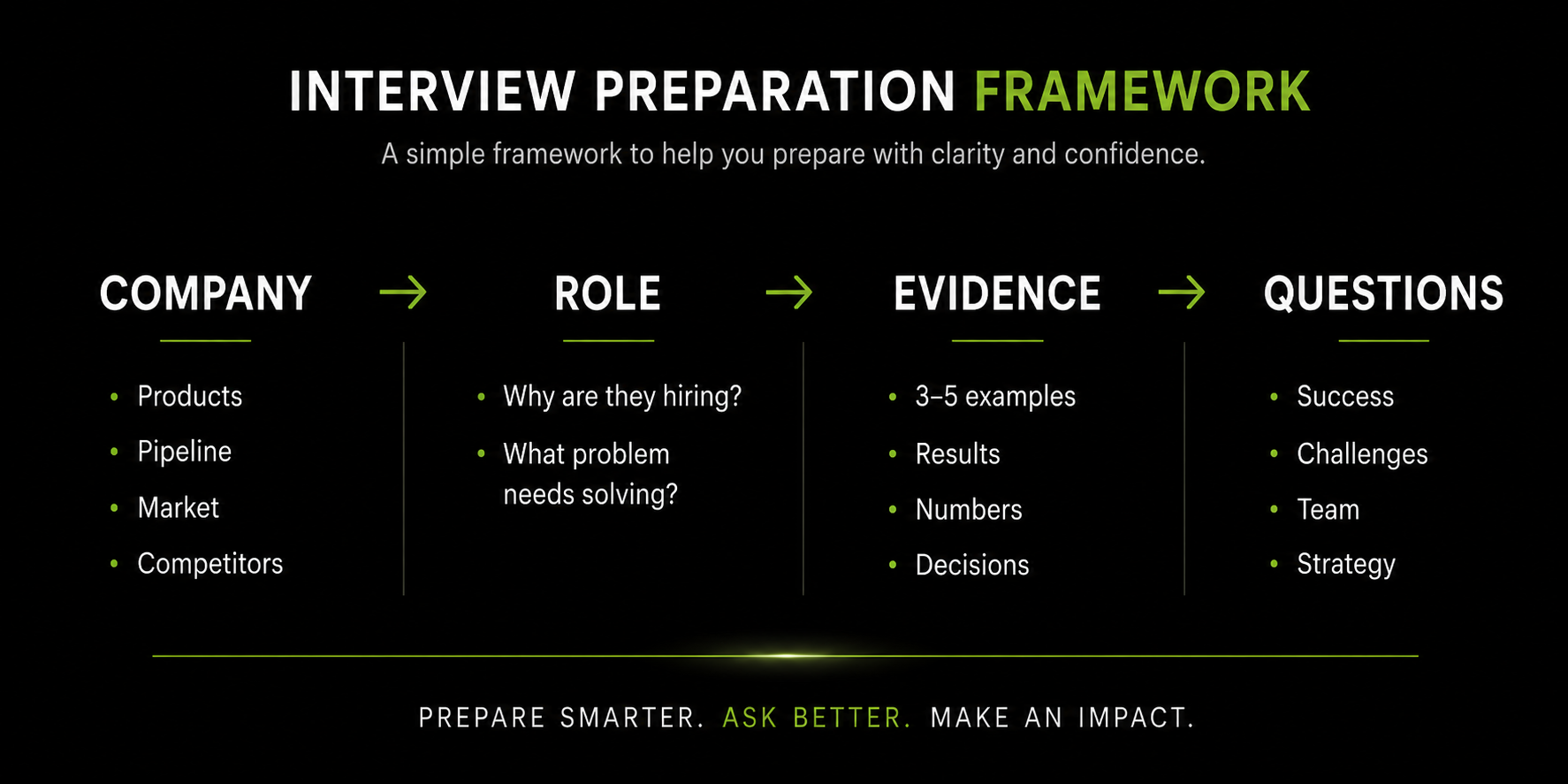
Understand what the company actually does, its main products or technology, the markets it operates in and what has been happening recently.
For a biotech, look at the pipeline and development stage. For a genomics or diagnostics company, understand where its technology sits in the workflow and what alternatives customers have. For a commercial role, know the market and competitors.
The goal isn't to memorise the company website. It's to walk into the interview understanding the business you're potentially joining.
3. Work out why they're actually hiring
A job description tells you what the company wants someone to do.
It doesn't always tell you why they need someone to do it.
Perhaps a territory isn't performing. A product is launching. A clinical programme is moving into its next phase. The company is entering Europe. A team is scaling. Or someone simply left.
Try to understand the problem behind the vacancy. Once you do, you can connect your experience to what the company actually needs rather than spending the interview walking through your CV.
Don't prepare only for the job description. Prepare for the problem behind the hire.
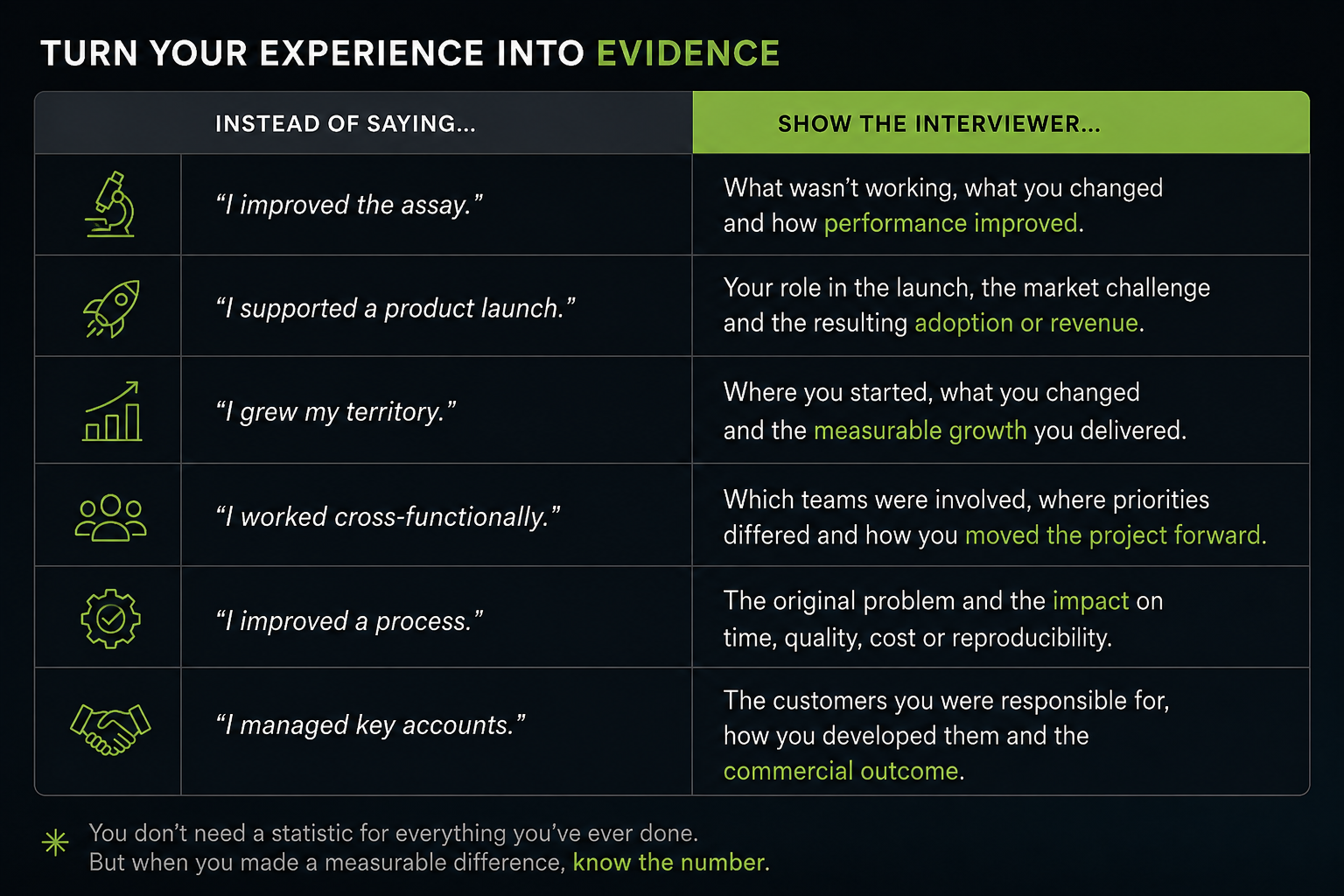
4. Bring evidence, not just claims
Saying you're commercially successful, technically strong or good at solving problems doesn't give an interviewer much to work with.
Show them.
For scientific roles, that might mean discussing an assay you improved, a difficult experiment you troubleshot, validation work you completed or a process you made more reproducible.
For commercial roles, it could be revenue growth, accounts won, market share, product adoption, territory development or a successful launch.
For clinical, regulatory and operational positions, it might be timelines shortened, submissions supported, milestones achieved or processes improved.
Current biotech hiring guidance increasingly emphasises measurable outcomes and demonstrable capability rather than relying purely on job titles and credentials.
You don't need a statistic for everything you've ever done. But when you made a measurable difference, know the number.
5. Be ready to explain how you think
For technical positions especially, the interviewer may be less interested in whether you know the “correct” answer than in how you arrive at one.
Technical assessments, troubleshooting exercises and scientific Q&A are commonly used for laboratory, quality, engineering and scientific positions.
If you're given a problem, talk through your reasoning. What would you check first? What could be causing the problem? What evidence would you need? What would make you change direction?
The same applies outside the laboratory.
If you're asked how you'd enter a new market or deal with a difficult customer, don't rush towards an impressive-sounding answer. Explain your thinking.
Good judgement is easier to see when you show how you reached the decision.
6. Talk about impact, not just activity
There's a subtle but important difference between describing what you did and explaining what happened because you did it.
“I managed distributor relationships across Europe” tells the interviewer your responsibility.
“I identified underperforming markets, changed how we supported distributors and grew the territory by X%” tells them your impact.
The same principle works in the laboratory.
“I was responsible for assay optimisation” is useful context.
Explaining the problem, what you changed and how that affected performance is much stronger.
This is essentially why structured answers such as STAR work. The framework itself isn't particularly magical. Specificity is.
7. Show that you can work beyond your own function
Life sciences companies are increasingly interconnected.
Scientists work with bioinformatics teams. R&D works with clinical and regulatory. Product teams work with marketing and sales. Commercial teams work with scientific affairs, customers and operations.
That makes cross-functional experience valuable, and current hiring guidance repeatedly identifies the ability to work across teams as an important capability.
Prepare at least one example where you had to work with people who approached a problem differently from you.
For more senior roles, this becomes even more important. Leadership is rarely about what you can achieve alone.
The further you progress in your career, the more your ability to connect people, science and business starts to matter.
8. Don't bluff what you don't know
Life sciences is too specialised for anyone to know everything.
If you're asked about a methodology, technology or therapeutic area you haven't worked with, don't invent expertise.
Explain what you do know, where your experience overlaps and how you would approach learning the unfamiliar area.
There is a considerable difference between saying “I haven't worked directly with that” and “I don't understand it.”
Good interviewers know the difference too.
9. Ask better questions
The questions at the end of an interview shouldn't be treated as something you need to get through before leaving.
They're one of your best opportunities to understand the role properly.
Ask why the position is available. Ask what the biggest challenge is. Ask what success would look like after six or twelve months. Ask how the team works together. Ask what is changing within the business.
For senior positions, go further. Understand the authority attached to the role, the company's strategic priorities and where leadership believes the biggest gaps currently exist. Current life sciences interview guidance specifically recommends exploring the history, scope and authority of senior roles rather than focusing only on responsibilities.
Remember, you're making a decision too.
A good interview should leave both sides with a better understanding of whether the fit actually makes sense.
10. Follow up, but keep it simple
You don't need to send an essay after the interview.
A short message thanking the interviewer for their time, mentioning something specific you enjoyed discussing and confirming your interest is enough.
If there was something you promised to provide, send it. If an important question occurred to you afterwards, ask it.
Then give the process some room to move.
Enthusiasm is good.
Seven follow-up emails before Friday is perhaps slightly less so.
The interview is really about making your value easy to understand
The life sciences hiring market is becoming more capability-driven. Employers want scientific expertise, but increasingly they also want evidence of problem-solving, communication, commercial awareness, cross-functional working and measurable impact.
That doesn't mean you need to turn every answer into a perfectly rehearsed performance.
Quite the opposite.
Know your experience. Know your numbers. Understand the company. Think about the problems you've solved and be prepared to explain your decisions clearly.
Your CV helped get you into the conversation. The interview is where you show what sits behind it.
Looking for your next Life Sciences opportunity?
Opus Recruiter works with professionals and companies across biotechnology, pharmaceuticals, genomics, molecular diagnostics, MedTech and the wider Life Sciences industry.
Whether you're considering your next career move or simply want to understand what opportunities are available in the market, we'd be happy to connect.
Looking for your next opportunity?
Explore the latest opportunities with Opus Recruiter or connect with our team to discuss your next move.
Hiring in Life Sciences?
Find out how Opus Recruiter – Life Sciences Recruitment can help you identify specialist scientific, technical, commercial and leadership talent.