

When it comes to recruitment, no two industries are exactly the same.
Every sector has its own particular staffing headache. Some are battling genuine skills shortages. Others are caught in the awkward middle of a skills evolution, where the jobs have changed faster than the talent pool has. Some have an oversupply of candidates, but very few with the right experience. Others are dealing with shrinking talent pools, highly regulated qualifications, geographical limitations or fierce competition for the same people.
And then you add the individual company into the mix.
Because finding someone with the right qualification is only the starting point. They also need the right experience, technical ability, personality, cultural fit, expectations, location, salary requirements and, increasingly, the ability to work within a company's particular way of doing things.
Recruitment is therefore a little more complicated than putting a job advert online and waiting for the right CV to land in your inbox. It requires a fair amount of judgment and detective work.
(Especially in a world where the algorithms designed to connect employers and candidates don't necessarily understand all the dots that a good recruiter is looking for.)
But there's another side to the equation that gets far less attention.
What if the challenge isn't just finding people - but keeping them?
Because even the best recruitment strategy won't solve a retention problem if the underlying working environment is making people want to leave.
This brings us to something far more difficult to measure:
Job satisfaction.
There is no single global ranking of the "toughest industries to work in". And job satisfaction on its own isn't enough to tell the story either. You can love what you do and still be exhausted by the conditions around it.
So we looked beyond satisfaction, examining burnout, wellbeing, intention to leave, turnover, workload, work-life balance, engagement and working conditions, to understand which are toughest industries to work in.
The result is our Opus Evidence Score — an editorial assessment of where the data suggests employees face some of the toughest working environments.
And some of the results may surprise you.
The 10 Toughest Industries to Work In
We pulled together evidence from organisations including the World Health Organization, International Labour Organization, OECD, Gallup and the European Agency for Safety and Health at Work, looking for something more meaningful than a single "happiest workers" survey. Because one bad Tuesday doesn't make a bad job. We're interested in the patterns.
Long or excessive working hours
Persistent levels of burnout and workplace stress
Employees considering leaving their roles or professions
High turnover and ongoing retention challenges
Skills shortages increasing pressure on existing employees
Working conditions that affect wellbeing and work-life balance
Here's what we found:
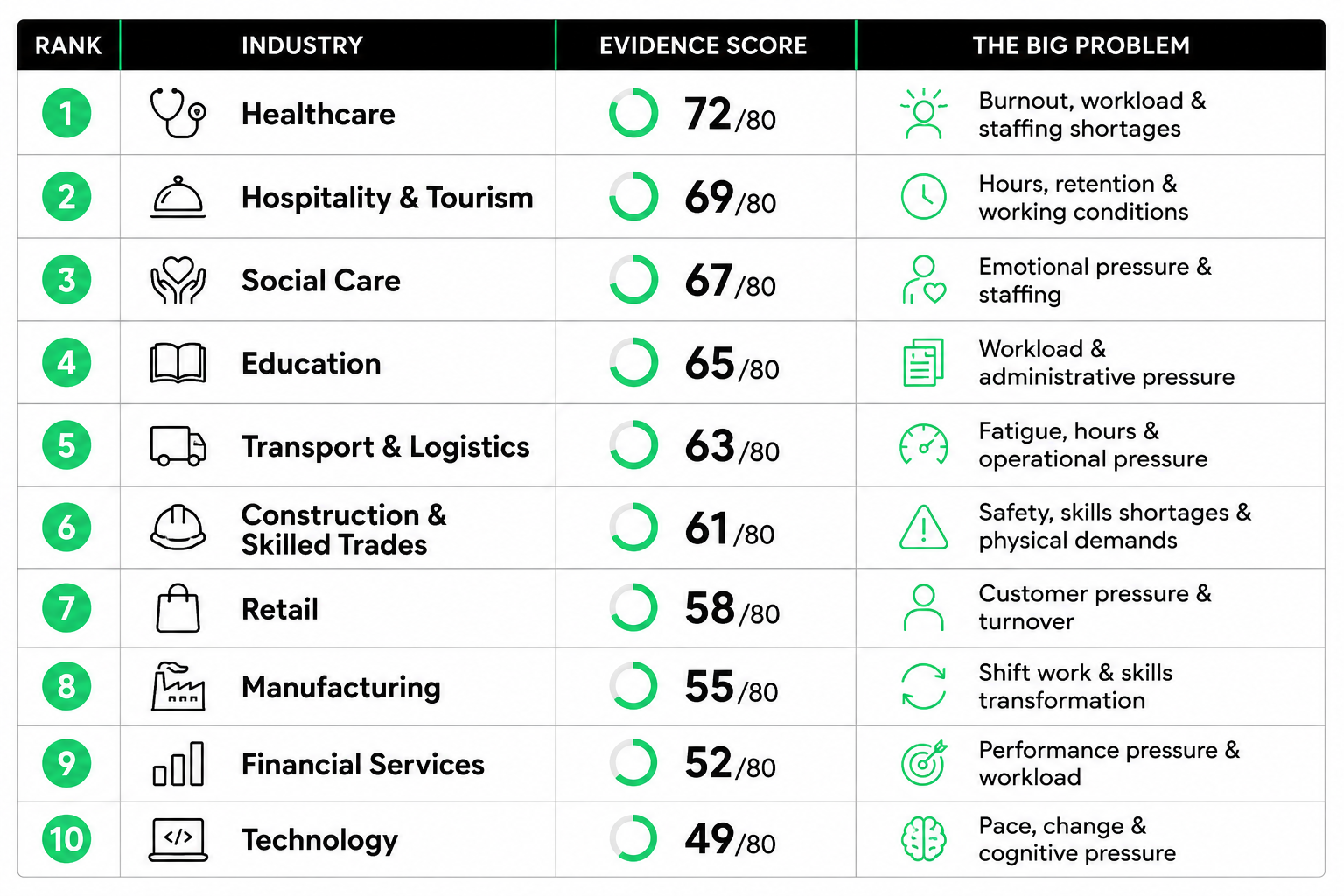
(The Opus Evidence Score combines the available evidence across burnout, wellbeing, workload, work-life balance, intention to leave, turnover, working conditions and skills pressure. It is an Opus editorial assessment rather than an industry-wide employee satisfaction survey.)
1. Healthcare
The job where "we're short-staffed" isn't just a management problem. It's everyone's problem.
Healthcare takes the top spot, and it's not particularly difficult to understand why. Healthcare workers aren't dealing with one source of pressure. They're dealing with several at once.
Long hours.
Emotional exhaustion.
Staff shortages.
High workloads.
Shift work.
And, in many cases, the knowledge that someone else's wellbeing depends on you getting things right.
The World Health Organization has found widespread evidence of burnout, anxiety and depression among health and care workers. In its 2024 review, at least one in four health and care workers reported symptoms of anxiety, depression and burnout during the pandemic period. And the problem hasn't magically disappeared now that COVID-19 has.
WHO Europe's 2025 survey of more than 90,000 health workers across 29 countries found that one in four doctors reported working more than 50 hours a week. Between 11% and 34% of health workers said they were considering leaving their jobs, depending on the country and profession.
2. Hospitality & Tourism
The industry where "there are plenty of applicants" and "we can't find anyone" can both be true.
Hospitality is fascinating because the talent shortage isn't always about numbers. It's about fit.
FA five-star lodge in a remote location might have a vacancy that looks perfectly reasonable on paper. Then reality arrives.
The candidate needs to relocate.
They need to be happy living on-site.
They need to work weekends.
They need the right experience.
They need to accept the salary.
They need to fit the culture.
And ideally, they'd like to have a life somewhere in between all of that.
Suddenly your enormous "talent pool" isn't looking quite so enormous.
The International Labour Organization identifies long and variable working hours, low wages, limited social protection, occupational safety concerns and skills shortages among the challenges facing tourism, hotel and food-and-beverage workers.
EU-OSHA also identifies shift work, long hours, customer aggression, job insecurity and poor work-life balance as psychosocial risks within hospitality.
Which makes hospitality one of the clearest examples of something recruiters see every day: A candidate can be qualified for a job and still be completely unsuitable for the life that comes with it.
3. Social Care
Meaningful work doesn't mean easy work.
There is a tendency to romanticise caring professions. People who work in social care often genuinely care about what they do.
That's the good bit. The difficult bit is that caring deeply about your work doesn't make emotional exhaustion disappear. You're supporting people who may be vulnerable, elderly, disabled or living with complex needs.
You're dealing with families.
You're dealing with difficult situations.
And you're often doing it while the system itself is under pressure.
WHO has highlighted the mental-health challenges facing health and care workers, including high stress, burnout and poor working conditions. And once staffing levels fall, the emotional workload doesn't fall with them. It gets redistributed. Usually to the people who stayed.
4. Education
Teachers can love teaching and still hate everything surrounding it.
This is one of the most interesting findings in the data. The OECD's TALIS 2024 research found that excessive administrative work is a major source of teacher stress across education systems.
In South Africa, the numbers are particularly striking:
72% cited too much marking as a significant source of stress.
70% cited responsibility for student achievement.
66% cited excessive administrative work.
30% reported experiencing a lot of work-related stress.
And yet... 85% of South African teachers said they were satisfied with their jobs overall.
Read that again.
High stress.
Heavy workload.
High job satisfaction.
It sounds contradictory until you remember that people don't necessarily leave because they dislike the profession.
Sometimes they leave because they can no longer sustain the conditions around it.
5. Transport & Logistics
When everything is urgent, eventually someone pays the price.
Transport and logistics doesn't really do "quiet periods". There is always another delivery, another shipment, another route, another deadline. And if one person is missing, someone else usually picks up the slack.
For drivers, fatigue and working hours are obvious concerns. The ILO identifies excessive working time and fatigue as significant occupational safety issues in road transport.
For warehouse and logistics teams, the pressure can look different.
Volume increases.
Deadlines tighten.
Customers expect faster delivery.
And staffing shortages turn directly into operational pressure.
6. Construction & Skilled Trades
The people everyone needs — and somehow nobody has enough of.
Construction has a recruitment problem that isn't going away anytime soon. The industry needs people with practical experience, technical knowledge and increasingly specialised skills. But many markets are dealing with ageing workforces and difficulty attracting enough new workers into skilled trades. And the work itself isn't exactly known for being gentle.
Physical demands.
Weather.
Safety risks.
Project deadlines.
Early starts.
Long days.
And the occasional moment when someone discovers that the blueprint and reality have had a disagreement.
The ILO identifies occupational safety and decent working conditions as important challenges across physically demanding sectors, while skills development is increasingly important as construction technologies change.
7. Retail
The industry where the customer isn't always right. But the employee still has to smile.
Retail workers deal with something many office-based jobs don't: constant interaction with the public. And the public can be... unpredictable.
Customer complaints.
Targets.
Busy periods.
Understaffed shifts.
Stock problems.
Returns.
And sometimes taking the blame for a company policy you had absolutely nothing to do with creating.
EU-OSHA identifies customer demands, workload, violence and harassment, low control and low support as psychosocial risks across service-sector work, including retail. The result is an industry where turnover can become self-perpetuating.
Someone leaves.
The team gets smaller.
The workload increases.
Someone else leaves.
The cycle continues.
8. Manufacturing
The factory changed. The talent pool didn't always get the memo.
Manufacturing is no longer simply about machines and production lines. Automation, robotics, digital systems, data and advanced manufacturing technologies are changing the skills employers need. Which creates a rather awkward problem. The industry may have plenty of workers. It just doesn't necessarily have enough workers with the right skills. That's an entirely different problem.
And then there are the traditional pressures:
Shift work.
Production targets.
Physical demands.
Safety requirements.
Repetitive work.
The challenge is increasingly to build a workforce that can operate today's systems while preparing for tomorrow's.
9. Financial Services
Good salaries don't make deadlines disappear.
Financial services doesn't look like a difficult industry in the same way healthcare or construction does.
The offices are comfortable.
The salaries can be attractive.
The work is often intellectually stimulating.
And yet pressure can still be enormous.
Performance targets.
Client expectations.
Regulation.
Deadlines.
Responsibility.
And, in some roles, a culture where "busy" is practically a job title.
Research into psychosocial risks in the service sector identifies workload, customer demands, low control and interpersonal pressures across financial services and other service industries.
The lesson here is simple:
Money can compensate for pressure. It doesn't eliminate it.
10. Technology
The industry where yesterday's skills can become tomorrow's obsolete skills.
Technology gets the number ten spot, but for completely different reasons from healthcare or construction.
The physical working environment may be considerably easier.
The cognitive environment isn't necessarily so forgiving.
Technology workers are expected to keep learning.
Then learn something else.
Then adopt another tool.
Then adapt to AI.
Then explain why the AI isn't doing the job yet.
The pace of change itself becomes part of the workload.
And when an industry changes this quickly, employees can experience a different kind of pressure:
"Am I still relevant?"
That question doesn't appear on most job descriptions.
But it can sit quietly in the background of an entire career.
The bigger picture
Ultimately, a tough industry doesn't necessarily mean unhappy employees.
People can love what they do and still struggle with the conditions around it. They can find their work meaningful, rewarding and fulfilling while also feeling exhausted, under pressure or uncertain about the future.
And perhaps that's the most interesting finding of all: job satisfaction and job difficulty aren't opposites.
Sometimes, the real challenge isn't the work itself. It's whether the environment makes that work sustainable.