

For anyone working in genomics, Oxford Nanopore needs little introduction.
Its nanopore technology has helped push long-read sequencing beyond the traditional lab setup, from the portable MinION to high-throughput PromethION systems, with sequencing happening in real time.
But behind that technology sits a complicated physical supply chain.
Oxford Nanopore isn't just building sequencers. It has to keep instruments, electronics, flow cells, sequencing kits, reagents and biological components moving together, while the technology itself continues to evolve.
New platforms arrive. Chemistries change. Manufacturing scales. Applications expand.
And the supply chain has to keep up.
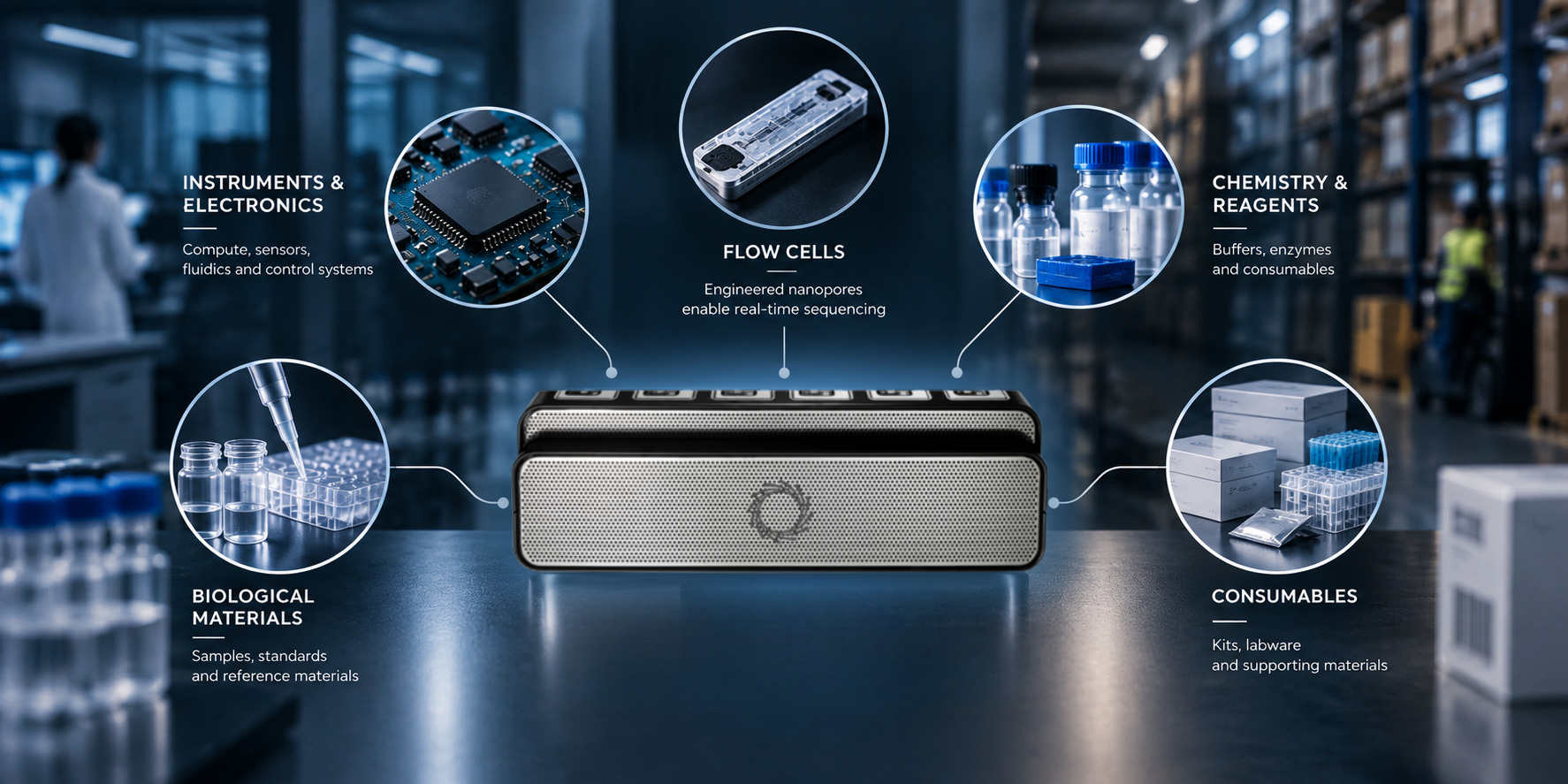
THE SUPPLY CHAIN BEHIND THE SEQUENCER
Hardware + electronics + flow cells + chemistry + biological components + consumables
All moving at different speeds, with different constraints.
That is what makes Oxford Nanopore's move towards demand-driven planning interesting.
It wasn't trying to optimise a simple manufacturing operation. It was trying to build a supply chain capable of keeping pace with a rapidly evolving sequencing technology and a growing global business.
Scaling sequencing means scaling the supply chain
Oxford Nanopore wasn't standing still while its planning model changed.
The company reported £223.9 million in revenue in 2025, up 22% from £183.2 million in 2024. Manufacturing was expanding too, with Oxford Nanopore reporting additional manufacturing and logistics capacity and the introduction of next-generation automated production during 2025.
The business has also been developing across research, clinical, biopharma and applied markets.
That creates pressure in places that aren't always obvious from the outside. A new chemistry, device configuration or workflow can affect demand across multiple SKUs. Some components are shared; others are highly specialised. Supplier lead times vary.
And an instrument already sitting in a customer's lab is only useful if the flow cells, kits and reagents needed to run it are available.
So the planning problem was growing with the company. Oxford Nanopore needed to coordinate inventory across a product ecosystem that was becoming larger and technically more complex.
A five-year DDMRP journey
Oxford Nanopore's shift to DDMRP wasn't a quick implementation.
By 2024, members of its supply-chain team were describing it as a five-year journey, placing the beginning of the transformation at around 2019.
And the presentation they gave at SAPICS wasn't called Our Successful DDMRP Transformation.
It was called:
“How NOT to Implement DDMRP”
Oliver Jones & Luis Freitas, Oxford Nanopore Technologies
SAPICS 2024 Best Written Paper
SAPICS confirms Jones and Freitas received the Best Written Paper recognition for their work on the five-year DDMRP journey. Jones has held DDMRP and supply-planning roles at Oxford Nanopore, while Freitas has worked within its Supply Chain Centre of Excellence.
The title gives us a useful clue about the journey. This wasn't DDMRP switched on and problem solved. Their experience developed over several years, with lessons around implementation, adoption and how the methodology fitted into the wider organisation.
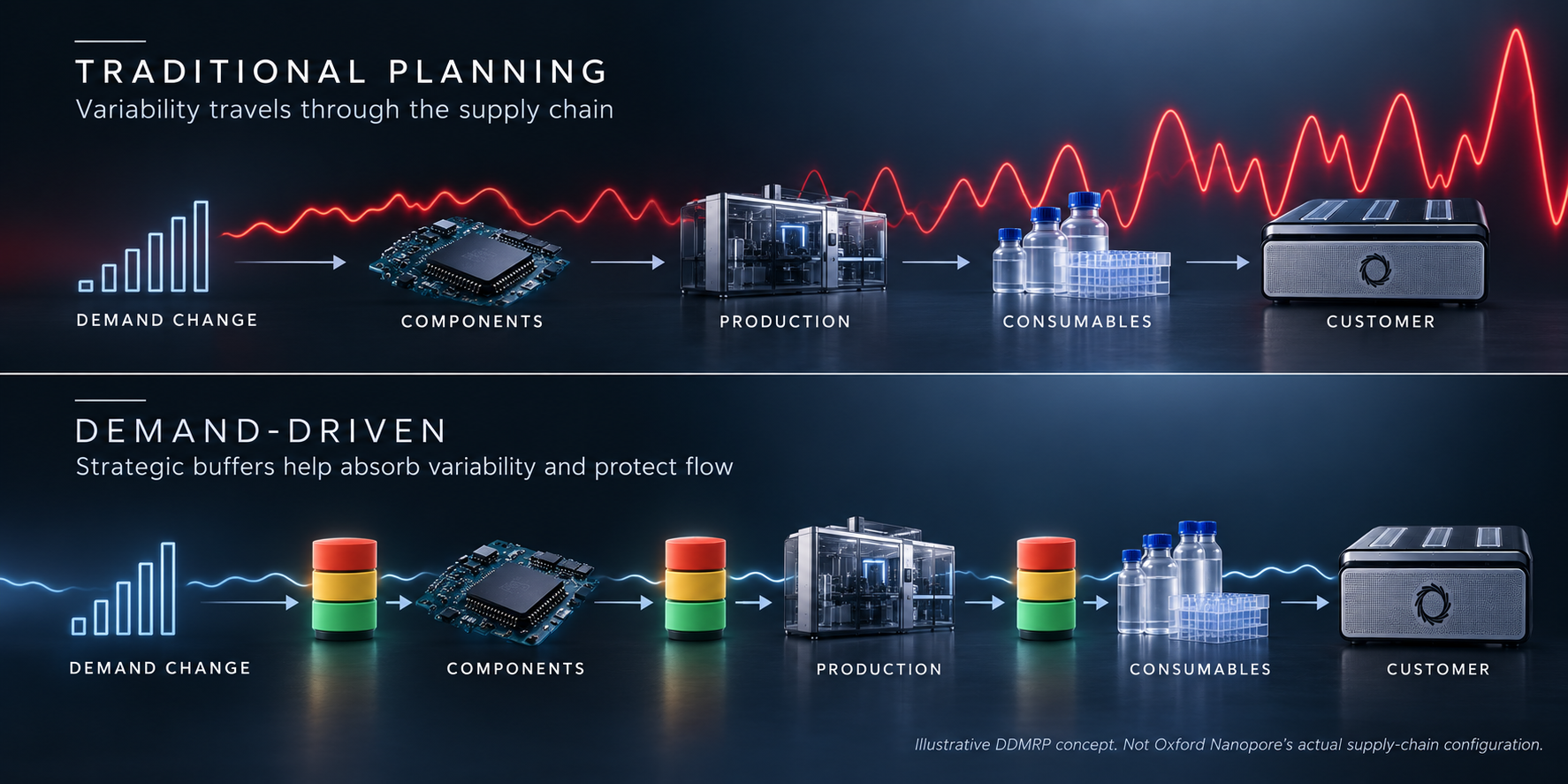
For anyone new to DDMRP, the basic idea is relatively simple: strategically position inventory buffers to protect flow, then use actual demand and those buffer positions to help drive replenishment rather than allowing detailed forecasts to dictate every short-term supply decision.
New to DDMRP? Read: What Is DDMRP? A Practical Guide to Demand Driven Material Requirements Planning
Oxford Nanopore was doing this while its product portfolio, manufacturing operation and business continued to develop.
That's a much more interesting environment in which to test a different way of planning.
Beyond the software
Oxford Nanopore hasn't publicly documented every detail of how its DDMRP model was configured, but the programme appears to have moved well beyond an isolated planning experiment.
In commentary later shared by Oxford Nanopore's Oliver Jones, CIPS judges described the programme as DDMRP being adopted in a “high-complexity, fast-growth environment”, and referred to its “long-term integration into business rhythm.”
Supply-chain strategist Ken Titmuss has a phrase he uses when companies start looking for the technology that will solve their planning problems:
“Thoughtware before software.”
Ken Titmuss, Supply Chain Strategist
Software can calculate buffers and generate signals. It can't decide why inventory should sit in a particular place, what variability it needs to protect against, or whether the organisation will actually trust and act on those signals.
Oxford Nanopore's five-year journey is useful in that context. The public accounts of the programme point to a change that developed over time rather than a standalone software implementation.
The inventory numbers
Practitioner material associated with the programme reports a 20% reduction in raw-material inventory within the scope of DDMRP and a 47% reduction in finished-goods inventory in one value stream.
The same practitioner material also reports a 300% increase in adoption of the DDMRP system, although the exact wording used for this measure varies between available summaries. These are programme-level practitioner figures rather than audited company-wide results.
20%
reduction in raw-material inventory*
47%
reduction in finished goods in one value stream*
300%
increase in orders through the DDMRP system*
Figures reported in practitioner accounts of Oxford Nanopore's DDMRP programme. They relate to specific scopes and should not be read as audited company-wide results.
Oxford Nanopore's financial reporting gives us a separate company-wide view.
Group inventory stood at £101.5 million at the end of 2023, £99.5 million at the end of 2024, and £81.5 million at the end of 2025.
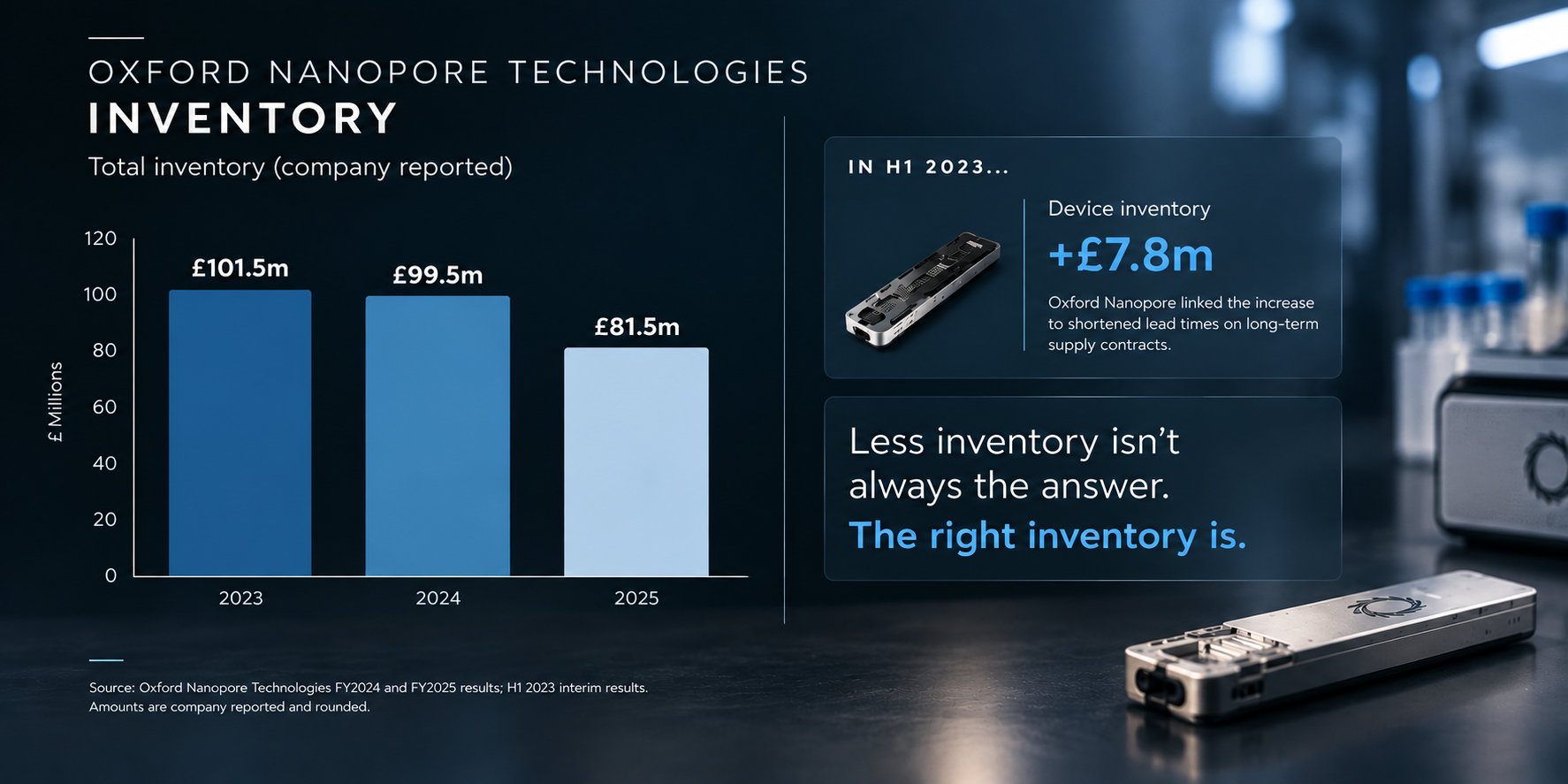
That's a reduction of £20 million between the end of 2023 and 2025.
But DDMRP can't simply be credited with it.
Oxford Nanopore's public financial reports don't attribute those company-wide inventory movements directly to DDMRP. The business was also changing manufacturing capacity, product mix, supplier arrangements and working-capital management during the period.
There is another detail in Oxford Nanopore's reporting that makes the inventory story more interesting.
In H1 2023, device inventory increased by £7.8 million. Oxford Nanopore explained that it had taken steps to secure long-term inventory supply to mitigate global supply risks, with the increase in device inventory resulting from shortened lead times on long-term supply contracts.
So inventory wasn't simply being driven down.
This connects with another idea Ken Titmuss has discussed with us: bimodal inventory. A business can be carrying too much stock overall while still having too little of the materials it actually needs.
Anyone who has worked around life-science manufacturing will recognise the problem. You can have millions sitting in inventory and still be waiting for one reagent, validated component or specialised material before something can be produced or shipped.
Millions in inventory. Still waiting for one reagent.
Total inventory doesn't tell you whether the right inventory is in the right place.
Oxford Nanopore's financial reporting doesn't tell us how individual DDMRP buffers influenced those decisions. It does show why looking only at the total value of inventory can miss what is happening underneath.
From a five-year journey to CIPS Overall Winner
In 2025, Oxford Nanopore won Best Practice in Supply Chain Integration at the CIPS Excellence in Procurement & Supply Awards.
Oliver Jones subsequently reported that Oxford Nanopore was also named the Overall Winner, sharing commentary from the CIPS judges that described the company's adoption of DDMRP in a high-complexity, fast-growth environment and highlighted its execution maturity and integration into the business.
BEST PRACTICE IN SUPPLY CHAIN INTEGRATION
+
2025 CIPS OVERALL WINNER
Oxford Nanopore Technologies
The recognition adds another layer to the practitioner-reported results: the transformation was assessed through a major procurement and supply-chain awards programme and received its Supply Chain Integration award, with the overall recognition subsequently reported by the Oxford Nanopore team.
What can life sciences take from this?
Oxford Nanopore's supply chain is unusual, but many of the pressures aren't: long lead times, complex BOMs, biological and chemical inputs, shelf-life constraints, rapid product changes and unpredictable demand.
In genomics there is another dependency. A sequencer can be installed and ready to run, but without the right flow cell, kit or reagent, the experiment isn't happening.
Oxford Nanopore doesn't prove DDMRP is right for every life-science company. It gives us a useful example of demand-driven planning being applied over several years inside a complex genomics business, with some strong practitioner-reported results and plenty learned along the way.
Want to continue the conversation?
Building a supply-chain or operations team in life sciences? Talk to Opus.
Or, if you're exploring DDMRP within your own organisation and would like to speak with Ken Titmuss, let us know and we'll make the introduction.
Sources & Further Reading
Oxford Nanopore Technologies. Preliminary Results for the Year Ended 31 December 2023.
nanoporetech.comOxford Nanopore Technologies. Annual Results for the Year Ended 31 December 2024.
View reportOxford Nanopore Technologies. Annual Results for the Year Ended 31 December 2025.
View reportOxford Nanopore Technologies. Interim Results for the Six Months Ended 30 June 2023.
View reportSAPICS. SAPICS 2024 Conference Ezine.
View publicationDemand Driven Institute. Authorized Instructors: Oliver Jones.
demanddriveninstitute.comCIPS. CIPS Excellence in Procurement & Supply Awards 2025: Best Practice in Supply Chain Integration.
CIPS awards announcementJones, Oliver. Oxford Nanopore Technologies: CIPS Excellence Awards 2025. Includes the CIPS judges' commentary and Overall Winner announcement.
View post
Expert Contribution
Ken Titmuss, Supply Chain Strategist. Commentary from Opus Recruiter's interview and discussions with Ken Titmuss, including “Thoughtware before software” and the concept of bimodal inventory.